Monday, May 27, 2013

How Lazy Scientific Documentation Makes for Bad Language

This post is about how lazy documentation befuddles language.  In my neck of the woods we have a good example brought to us by someone who didn’t take the time to check facts.  Farther north someone else (perhaps a geologist or geographer) gave us another doozy: A word so convoluted that when I tell Spanish speakers about it they shake their heads and utter something like, “How ridiculous can somebody be?”  Now I’m not calling anyone ridiculous…at least not overtly.  Still, bad scientific note taking can lead to things as foolish as making the adjective “the” into a proper noun and calling a puddle a beach.

A few years ago I was asked to contribute to a book about geographical terms.  The idea was to take local geographical (or geological) common names and explain them to a greater audience that might not be familiar with those words.  I thought that was a wonderful idea and still do.  After all, most of you have never heard the words mogote or charco or brecha.  Wouldn’t it be nice to have a dictionary written by experts in different parts of the country who can explain those local terms to everyone?  So a bunch of us stretching from the East Coast to the West Coast set out to write the book and the university funding the project put it all together.  It was fun and worthwhile.

It was during that assignment that I began thinking about how certain terms are valid and others are illogical.  Some were derived by adopting ancient words while others resulted through carelessness.  In the United States for example many geographical names are actually Indian words either changed into an English-sort-of rendition or they are the original Indian word.  Sometimes, however, things go terribly wrong and invariably that’s because someone was negligent.

Take the word la for example.  In Spanish the word la is the feminine form of “the”—and el is the masculine form.  I hope that’s not confusing.  Say, for example, you were to say la musica.  Translated that means, “the music.”  Here’s another example: La muchacha which means “the girl.”  But once upon a time someone was out in the field obtaining the “common names” (also called “folk names”) of various plants.  This uninspired person might have had a bad day, i.e. too much sun, not enough water, too many plants to name.  Who knows, but when our less-than-industrious so-and-so asked his/her local guide about a certain plant the guide probably said something like, “This is the coma.”  Except in Spanish it came out like, Esta es la coma.  I imagine that whoever was taking notes nodded and said something like, “Hmmm.”  And then he/she wrote down, la coma.  For years afterwards the little plant that goes by the scientific name of Bumelia celastrina or Sideroxylon celastrinum became “la coma” which translated into English is “the coma.”  Mind you the two Latinized names above are for the exact same plant; and perhaps you were taught that the “scientific name” is the definitive name.  Well, here’s a bit of bad news: Not even scientific names are sacrosanct these days.  Some texts have as many as three or even four “synonymous” scientific names which is another confusing story that perhaps I’ll try to tackle at some later date.  But let’s get back to the subject of lazy science and bad language.  Some of the more obsessive-compulsive science aficionados raised all kinds of hell when they started reading the words, “la coma” in botanical texts.  “That’s nuts!” we (I mean, they) yelled.  Little good it did because for years—as if immune to accuracy or legitimacy or even logic—the texts kept appearing with the words la coma written under the little woody plant that bears edible bluish-purple berries.  Over and again a dedicated group kept saying that the term was wrong and should be corrected.  But it was perhaps too late.  The botanical community had entrenched itself with the name la coma and no amount of reasoning or logic seemed to dissuade them.  Years went by and nothing changed.  Now, after a lot of preaching, people are starting to drop the word la and simply say, coma.  And that’s the real name.  It is called, coma.

But the real doozy is a word used by geologists and geographers that is so bizarre it boggles the mind.  That word is “playa” that for nearly 500 million Spanish speakers around the world means “beach.”  Somehow, the word “playa” became a big puddle.  Well, it’s a bit more sophisticated than that from a geological perspective but essentially it’s a puddle.  So here’s my take on how a “beach” became a “puddle.”  Once upon a time a non-Spanish speaking persona was walking around with his/her guide (who may not have been all that adept at Spanish) and this persona asked, “What do you call that?”  The guide was confused but not wanting to sound ignorant or even stupid said, “playa” referring to perhaps the sandy edge of the puddle that reminded him of a beach.  “Ah,” the persona said trying to sound wise and contemplative.  And he/she wrote down in his/her notes that a puddle was called a playa.  And that sounded kind of neat so from hence forth said puddles were called playas.  Years ago I even saw a book entitled The Playas of Madison County” or something along those lines.  Actually, I think it was called The Playas of Kansas or maybe it was The Playas of Frisco Bay.  Either way the title threw me because on the cover was a picture of all these giant puddles.

So when I set out to contribute to the book on geographical names one of the words that landed on my desk was…yes, you got it…“playa.”  I asked one of the editors what definition they were expecting and the editor referred me to a geologist who said, “Well, everyone knows a playa is a well-drained….puddle."  Except, of course, she didn’t say the word puddle even though I kept imagining a puddle, or at least a small pond, as she spoke.  She seemed not the least concerned about the word’s larger meaning.  What mattered was how the word had been defined (regardless of how poorly) by her fellow geologists or geographers.  In an attempt to be tactful I wrote that what we were seeing is language evolving; and in fact that’s probably what is occurring.  Still, all of this mess results from someone’s laziness or ineptness in collecting proper terminology.

Trivialities to some; important issues to others.  But words matter and oftentimes people are lax in what they say or how they interpret what has been said to them.  It’s something worth thinking about.


                                         Coma

Friday, May 24, 2013

An Array of Crooked and Hook Knives (Part Two)

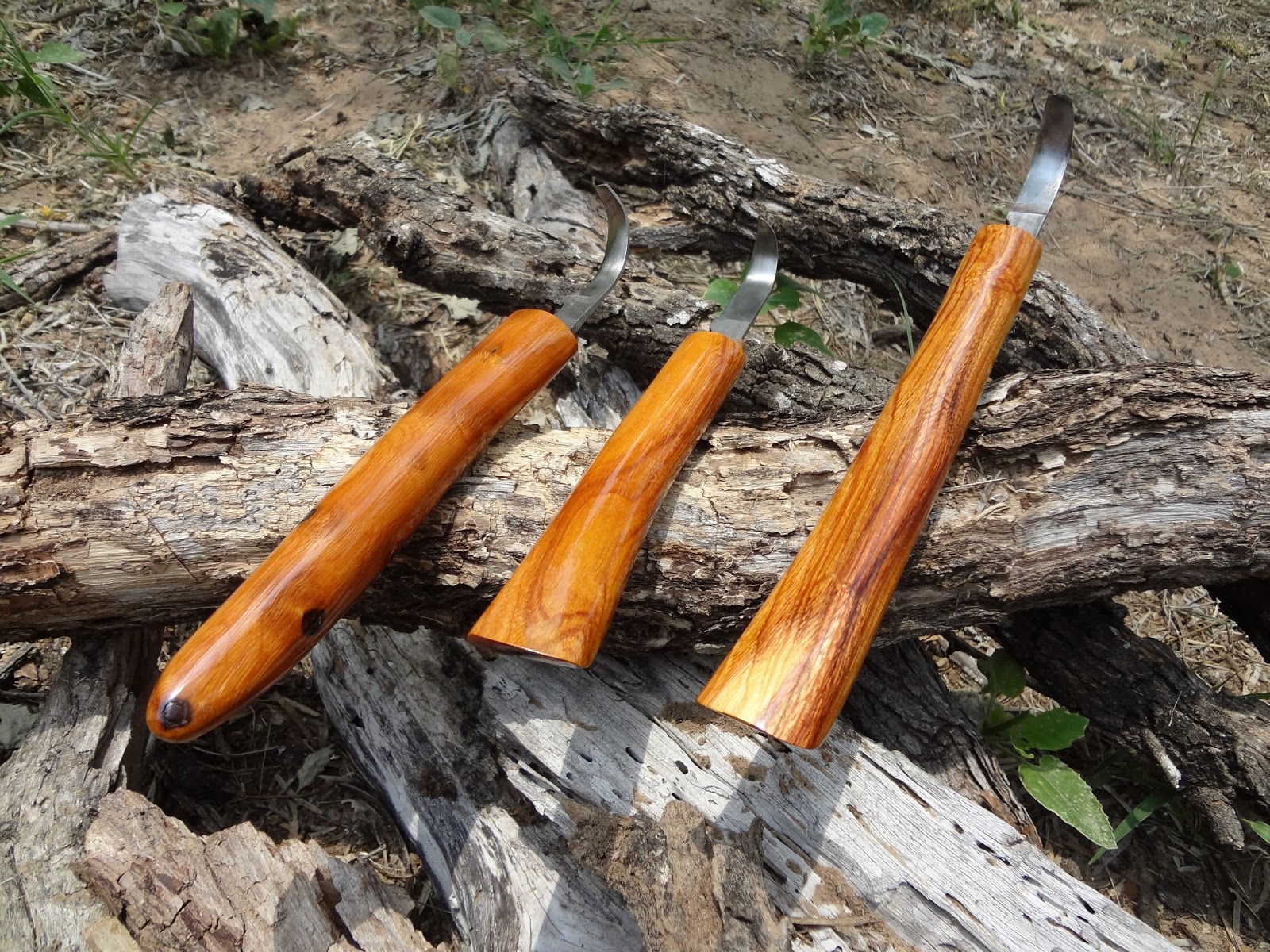
There’s not much deviation in design in the traditional crooked knife.  The hook knife on-the-other-hand can be quite varied.  That’s because the hook knife’s applications and thus specific shapes depend on the intended woodcarving.  For example, “hook” dimensions vary with the size of the spoon’s bowl or in making a ladle or coffee scoop.  Likewise, hook knives intended for carving figurines can have shallow hooks or deep hooks.  I’ve seen woodcarvers with as many as twenty hook knives in shapes and sizes to fit their many needs.  The knives pictured below are pretty standard though two of the hook knives have pointed tips and another hook has a flattened tip.  Novices will probably prefer the flattened tip hook knife but pros find the pointed tipped knives perhaps a bit more versatile.  Both crooked and hooked knives should be tempered between 58 and 63 Rockwell.  They are not intended for dry wood but nonetheless work better in that hardness range.

Handles can also vary with hook knives and even with crooked knives.  The traditional thumb perch in a crooked knife can be acute or moderate or even nonexistent to facilitate various handholding positions.  Native Americans used crooked knives in the palm up fashion.  I assume it has something to do with my wrist shape but I seldom use the palm upward handhold preferring a palm-downward handhold.  My wrists start aching when I employ the palm-up handhold, but I find no hindrance in using the knife palm-down.

Below are five more of my recent crooked knives and hook knives.  (Refer to my last post for additional photos of crooked and hook knives.)  These knives are fun to make though, as with any knife, caution must be taken to properly heat treat and temper the blades as well as obtain an exact chisel bevel.  A muffed bevel will make your knife difficult to use or perhaps even useless.  The exact angle varies in accordance to the application and likewise to the way you hold the knife.  It takes practice making knives and you’ll make dozens before you get it just right.  I was lucky to have grown up next to a blacksmith shop and thus learned the art of knife making as a kid.  I enjoy making knives as a hobby and occasionally sell one or give one away.  Here’s a note to those of you who might be thinking of making and selling knives.  Research the market carefully making extra note of liability and insurance costs.  A knife is a potentially dangerous tool and thus opens the maker and seller to certain legal issues.  Such is the litigious world we live in.  Some have suggested incorporation or LLC but I cannot address those issues and one should seek professional advice.  Risk/benefit criteria applies here and would-be knife-makers need to consider those realities. 


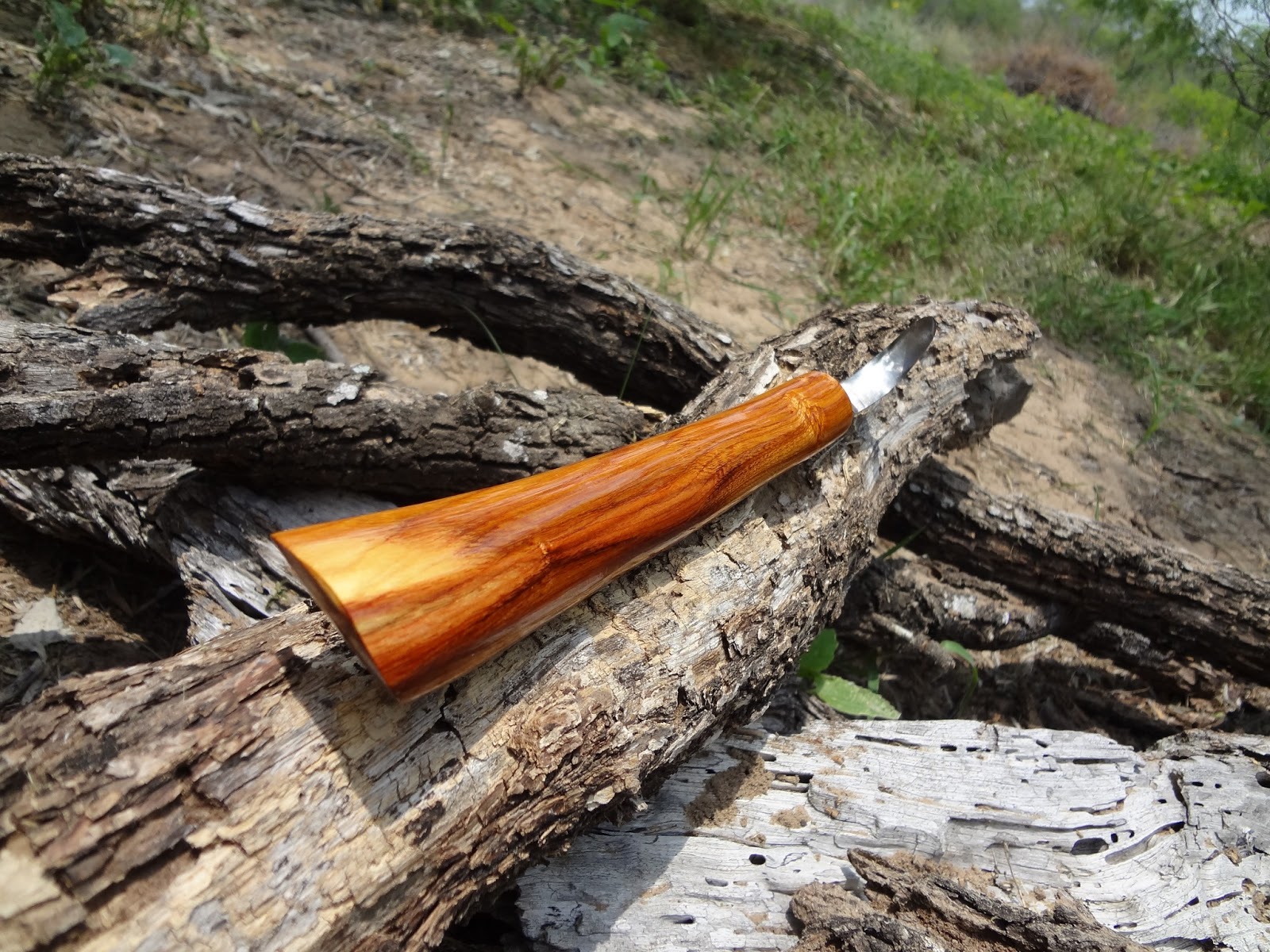
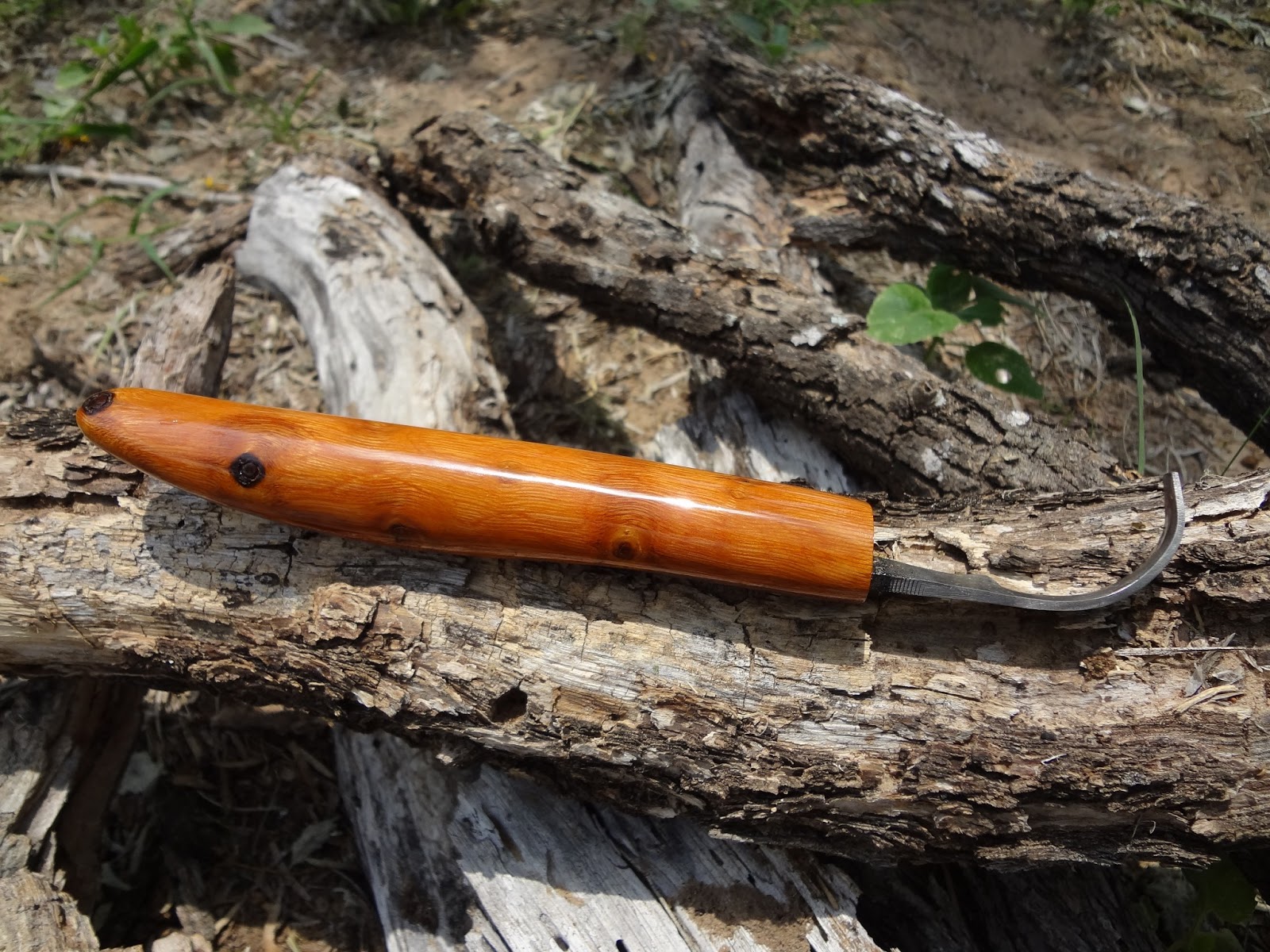
The above hook knife was made using a six-inch mill file and a piece of knifeleaf condalia.


The above crooked knife is a six inch mill file with a piece of mesquite root.  The root was lying out by a fence and had been there several months so the boring beetles had gotten to it.  I decided to use it anyway and filled the tiny holes with epoxy.


 Another crooked knife made from a six-inch mill file.  The wood is knifeleaf condalia.


 Hook knife above with a knifeleaf condalia handle and mill file blade.


 Hook knife above made from a mill file and piece of brasil wood.


Tuesday, May 21, 2013

An Array of New Crooked and Hook Knives (Part One)


It’s hot and humid and we finally got a few inches of rain the other day.  I’ve had some encounters with rattlesnakes but as long as they’re not around my front porch I leave them alone.  The other night I taught my son, Matthew, the finer points of working with a crooked knife.  We debarked several pieces of wood destined to be various things and then worked two of the pieces down to form handles for take-down bows.  In this post and the post to follow I include photos of some of my latest crooked and hook knives.  I hope you enjoy looking at them.  I still consider these knives my favorite woodcarving tools.


The knife above is guayacan wood mated to a six-inch mill file with the traditional chisel grind.  The thumb perch is exceedingly comfortable on this knife.


The three photos above are of a mesquite handle crooked knife.


This knife is a hybrid between the traditional crooked knife and the hook (or spoon) knife.  The blade is 1095 steel.  Note the sharp curve at the end of the blade for detail woodcarving or spoon making.  Also note the long straight blade section ideal for fine shaving tasks.  The handle is a species of Condalia.


The two photos above feature a detail-working hook knife for making small scoops or delicate woodcarving cuts or shaving.  I have another knife like this I’ve used for years for making coffee scoops.  The wood is lotebush and that’s a hard wood to work with because it tends to crack and check and must be dried very carefully.  The blade is 1095 steel.

In my next post I’ll feature five more knives.

Wednesday, May 15, 2013

Random Thoughts from a Couple of Weeks in the Life


A fellow lives in a big city surrounded by tens of thousands of houses with expressways nearby and jet planes flying overhead.  He retreats into his backyard amidst the noise and congestion and makes a selfbow and a set of arrows from a piece of elm and a bundle of river cane.  In an even bigger city on the other side of the country another fellow lives in an apartment encircled by more apartments and houses and tall buildings and dingy factories.  He sits in his living room watching television shows about survival as so-called “experts” go off into the wilds to battle the elements…replete with film crews and nearby helicopters just in case their skills fall short.  Midway in between the two great cities a man makes YouTube videos about “sustainable living.”  In the background one hears 18-wheeler trucks rumbling past on that great highway connecting the two megalopolises.

I recall a line from the old movie, Red Dawn, where the character playing the downed pilot says about war, “It’s here every day.”  Like that stretch of highway between San Antonio and Dallas or maybe between San Diego and San Francisco or Allentown and New York or Gary and Chicago.  Millions of cars and trucks race north or south or east and west.  You can stand ten miles away on either side of those freeways and hear the howling of all those vehicles.  If you happen to live near an international airport like DFW between Dallas and Fort Worth you no longer know what it’s like to live in quiet.

A few weeks ago I was in Galveston, Texas and as I skirted that place called Houston I came under the flight path of airliners queued into the distance making their approaches.  Twenty-four hours a day those planes land and on the other side they take off.  Does the mind become immune to the constant noise, I wonder?  Or does it work its way into the brain via channels that cannot be closed and then festers in places like the heart and lungs and even the bones?

I stayed at a motel in Dallas the other day and like every other motel in Texas saw that the people who keep it operating come from other places.  Cleaning the rooms and mowing the grass they speak no English.  Saw road crews manned by these same people.  Saw houses being built by the same crowd.  I see farms run by their kin and in fact I know of a nearby “farm” that were it not for those laborers there would be no food produced, no eggs gathered, no fields tended.  They are the bosses and if anyone thinks otherwise then they are simply fools!  Without them the entire system collapses within hours.

People struggle to make ends meet.  The masses often live from paycheck to paycheck.  They exist powerless: mere pawns and minions agreeably tethered ideologically, religiously and politically to their masters.  They turn on their radios or television sets and listen to people who tell them how and what to think.  They vote as instructed with nary a thought as to whether they have just acted outside their own interests.

I heard a lady say the other day she wanted to ban assault rifles and high capacity magazines because she wanted to “save lives.”  So I proposed a solution.  You say it’s all about saving lives, I said.  Okay, so let’s ban all assault rifles and high capacity magazines and make it illegal to possess them.  But at the same time you must ban abortion.  There was a moment of quiet and I asked: You want to save lives right?  The lady nodded but I could tell she wasn’t pleased with my plan.  So I said: How is it that you were so worked up about the killing of twenty innocent five-year-old children but then walk those same children back a few years (four, three, two, one and then a few months) and it’s perfectly okay to kill them in the womb?  If it’s really about saving lives then let’s save lives, I said.  But the lady countered with, “We don’t want women seeking abortions in unsafe places where they might die.”

There were one-million two-hundred thousand abortions (1.2 million) in the United States in 2011.  There were about 32,000 gun related deaths (most of them suicides) in 2011.  Now let’s do the math.  It would take 37.5 years of gun related deaths (at the 2011 rate) to equal one year of abortions in the USA at that same 2011 rate.  It would take 60,000 Newtown, Connecticut shootings to equal one year of abortions.  What happened in Newtown was beyond horrific.  For a man whose life is his children the thought of what those families are going through is impossible to comprehend.  Many of those parents went to Washington DC and pleaded with Congress to pass some sort of gun legislation.  But did you notice that not one (Not One Single Parent!) of the 1.2 million aborted children went to Washington DC to plead for any sort of anti-abortion bill?

I saw where one group is all lathered up because the IRS apparently targeted right-wing groups for scrutiny.  But that same group says nothing about the fact that the IRS did the exact same thing against left-leaning groups during the previous administration.  So maybe the real scandal is in allowing the tax exempt status of organizations (right or left) that are politically motivated while pretending to be socially focused?  Maybe that’s the cancer we need to excise?

A group of rose-breasted grosbeaks and blue grosbeaks came to visit and we watched them munching on suet and bird seed.  And last night the coyotes took to singing an old song I hadn’t heard in ages.  It was the one by Roy Orbison called, Crying over you.


Tuesday, April 30, 2013

Two Angry Females....


I’m not sure how to explain the photos other than to say that both bodies were lying a few feet from each other and it looked like they had been dead for only a couple of hours.  Even so, they were still quite beautiful.  Strange, how something so stunning can be so dangerous.  And yet, these females are in abundance out here.  Yesterday I found a bunch of them hiding in a row of concrete blocks placed to form a retaining wall near the cabin.  Each had a large egg case alongside and when I was messing with them one of the egg cases popped open and hundreds of little ones started running around.  The moms are fierce protectors of their young.  They’ll rush at you and if you’re not careful they’ll bite.  Ah yes, my friends they can mess up your life.  Woe to the fool who falls for the trap.  Did they kill each other?  Was it jealousy or a territorial dispute?  I guess it’s likely not jealousy since they terminate their mates when no longer needed.

You’ve heard of a cat fight?  Well, this is a fight with fangs and venom.  Some people report extreme pain upon being bitten while others say it didn’t hurt all that much.  Hmm, I think I’ve heard that before.  Nausea, muscle cramping, fever; the symptoms vary but if one is healthy then it’s not life threatening.  Still, who wants to be bit?  We’ve got another reclusive lady around here and I’ll tell you about her later.  Yes, the brushland desert is a mysterious place filled with all sorts of beauty.  But watch out for the temptress in black with the bright red birthmark on her belly.  She’s vicious when angry.  But then aren’t they all?


I spotted these two ladies on the trail walking back to the cabin.

Thursday, April 18, 2013

Prickly Pear Cactus: Sustenance for Generations of South Texans


The prehistoric people of South Texas lived as family groups and small bands.  Their languages were similar though moderate geographical isolation or distance spawned dialects that overtime evolved into new languages.  People living at the extremes of the region whether at the eastern end along the gulf shore or several hundred kilometers to the west could no longer understand each other after a few centuries.  Regardless, trade in essential goods continued and cultural similarities made coexistence possible.  These were basically nomadic people who relied on staple foods such as the prickly pear and mesquite as well as other plants.  Meat sources included small animals and the occasional deer and javelina.  Bison were rare and found only to the north of the South Texas Sand Sheet.  Deep South Texas was an amalgam of dense riparian woodland and sparser upland brush interspersed with native grasses.  The waterway known as the Rio Grande (in Mexico it is called El Río Bravo) was literally a raging river known for massive floods that stretched north and south for many kilometers.  Within the waterway were thousands of islands on which many natives lived.  Their chief mode of transportation was the dugout canoe made either from the trunk of a Montezuma bald cypress (Taxodium mucronatum) or Sabal palm (Sabal texana).  Those living near salt or freshwater ate fish and mollusks and those food sources were a boon for maintaining viable human populations.  Regardless, diseases like malaria and yellow fever were present and often made life difficult.


In the upland regions the people waged a continuous battle to find food and water.  The Sand Sheet farther to the north was a desert without surface water and with minimal food sources.  Spanish explorers reported that the vast desert was essentially unpopulated and prior to the arrival of the horse it is difficult to imagine that any natives ever chose to cross that expanse.  Migratory excursions would have been around The Sand Sheet to the west or perhaps along the coast.  Archeological digs on the northern part of The Sand Sheet in what is now known as Brooks County show that at the end of the Pleistocene about 11,700 years ago small groups of people lived along streams and rivers that flowed into the Gulf of Mexico.


Regardless of whether people lived in the rich riparian belts along the Rio Grande or in the sparser upland regions the main plant food source was probably the prickly pear cactus.  To the Indians of the region the prickly pear (Opuntia sp.) was a multiple food.  By that I mean that different parts of the plant offered sustenance all year long.  In addition the prickly pear (el nopal) provided for other human needs both medicinal and structural.

The vast majority of people living in South Texas today are of Native American decent.  Political designations aside (Hispanic, Latino) their genetic lines can be traced back over 10,000 years to the earliest settlements in the region.  Amazingly, few people in this vast area understand that they are the progeny of the original inhabitants of the land.  Even so, the culture is rich with telltale signs of the past.  Among those signs are the many uses of nopal that tell a story reaching back into distant millenniums.


The prickly pear is such an important plant that without it the ecology of the region would probably change dramatically.  For humans the prickly pear provides food from the young pads (nopalitos) and the fruit (tunas); and the sap is brewed into an alcoholic drink or used unfermented as a tea to treat various ills like gallstones, colitis and diarrhea.  Some people today use prickly pear to combat diabetes and benign prostatic hypertrophy.  The fruit is made into a sort of cheese known as queso de tuna.  When I was young spending summers at a remote ranch in southeastern Tamaulipas, Mexico I witnessed the native people using nopal as a poultice to treat burns and minor skin abrasions.  The sap or juice from the plant has been used to make candles and I have found the sap a particularly good source as a sealant in woodworking.  In making a survival bow, for example, use the thick nopal juices to cover the ends of the bowstave and thus keep the wood from checking.

We are currently experiencing an exceptional drought in South Texas.  But as far back as I can remember ranchers have used nopal pads to feed livestock when times get bad.  Prickly pear is not particularly high in protein but it will serve over the short haul.  One frequently hears the roar of a propane “prickly pear burner” hundreds of yards away as ranch hands scorch off nopal spines so cows can feed.  But cattle are a recent phenomenon (some would argue not particularly beneficial overall) and before that el nopal provided both protection and food to another animal that even today provides a nourishing fare for people living in remote mountain regions to the south.  Known as the “nopal rat” this large rodent builds its nests in clumps of prickly pear.  The nests often extend all around the plant with strategically placed entrance/escape holes.  The nest entrance/escape holes are usually guarded with the spines from another cactus known as tasajillo, (tas-ah-hee-oh).  Cooked over a spit or roasted in an oven these rodents are a delicacy.

Prickly pear ecology is a complex subject but whether as a prime nesting source for birds or a natural erosion control mechanism or an important source of honey during droughts the prickly pear has offered untold generations food, medicine and even shelter.  In parts of Mexico I’ve seen indigenous people use prickly pear as fences and on several occasions we constructed wickiup shelters using nopal pads as roofing material.  When the shelters crumble the pads fall to the ground and in a year’s time a number of new clumps mark the spot where the shelter once stood.

Sunday, April 7, 2013

The Coming World War over Water....


“Water is a big issue! Fresh water––while globally abundant–– is scarce in much of South Asia, northern China, the Middle East, and parts of Africa, and will become scarcer in the years ahead. At the same time, global demand for water for agricultural and industrial production and household uses is increasing steadily.  Experts at the Global Water Policy Project estimate that by 2025, 40 percent of the world’s population will live in countries that are ‘water stressed.’  These countries—most of which are in Africa and South Asia––will be unable to provide enough water for agricultural, industrial, and household needs."
Intelligence Challenges Through 2015
United States Central Intelligence Agency

Future historians—if indeed any exist—will question the mental state of the people of this era.  Economic and population growth was held sacrosanct even as resources were polluted and depleted.  Entire regions began suffering from drought but at the same time plutocrats pushed for more expansion while the oil and gas mafia injected precious underground water supplies with highly poisonous chemicals thus ensuring even those reserves could not be used.  Even the CIAs report above is not without its underlying political softballs.  Note that the document states that water is “globally abundant” and that shortages will only occur over there…you know in far off places like Africa and South Asia.  But a quick look at places nearby like South Texas tells a different story.  At this very moment politicians, bureaucrats and “developers” are in a state of panic.  Water reserves are critically low and some communities are now saying they will not be able to provide water this coming summer.  This is not an oddity.  Other places in the United States are also seeing looming water crises.  In South Texas most of the water comes from the Rio Grande that marks the border between the US and Mexico.  But the Rio Grande’s water shed occurs mainly in Mexico and thus the United States is dependent on its southern neighbor to release water into the river.  This is according to an international treaty stating that over periods of time Mexico must discharge water from its reserves into the Rio Grande so that the people of South Texas can have water for their cities and industries.  Of course we should keep in mind that the United States has either violated or ignored many treaties that did not serve its best interests and Mexico has been the victim of this tactic in decades past.  As one letter writer recently told me, “What goes around comes around.”  But you see Mexico is also experiencing an acute water crisis.  In fact, Mexico’s water reserves are even lower now than in the United States.  And according to the water sharing treaty Mexico still has two years before it must comply with its part of the deal.  In other words, even though the politicians, bureaucrats and “developers” are panicked there isn’t much they can do other than whine and perhaps threaten.  Mexico is completely within its rights to hold onto its water reserves for two more years.  But, of course, this type of situation has been predicted for a long time.  A perspicacious few have been telling folks in South Texas for decades that they should be less reckless and instead initiate serious water conservation measures.  The mindset however has always been to install water conservation ordinances when things are critical but to quickly abandon those ordinances the minute the water situation rebounds.  But here are some frightening facts.  The two large reservoirs that hold water along the Rio Grande in South Texas can go from high to extremely low in less than a year given current demand.  Nonetheless, the business community and their politicians can be likened to the sinner who begs for mercy when in a tight spot but quickly goes back to his evil ways when things improve.

Here are some more facts: American intelligence community reports predict that wars are going to be waged over water shortages.  It will no longer be a matter of who has the great oil reserves but instead who has water.  Consider this: If you were a kid growing up in the United States in the 1960s the population was about 165 million people.  Today the US population is over 300 million and some are saying its closer to 350 million.  By the way, for all of you young “bushcrafters” out there who are going to the woods to make feather sticks, baton pieces of wood and otherwise partake of the wilds I’ve got some very bad news.  There ain’t any wild left…at least not in the contiguous 48 states!  In fact, what you perceive of as wild is in reality just a sort of playground where you can go and pretend.  Fifty years ago there were less than half the people on this land than there are now.  Your perceived wilderness experience is what those living a half-century ago called a picnic at the city park.  Add to that resources are depleting at light speed!  While some are frenzied over buying another knife or axe or piece of high-tech camping gear maybe it would be better if they made do with less and thus stopped participating in the rape of nature.  Just a thought but what I see in so many forums and “bushcraft/camping” blogs is nothing more than buy, buy, buy and more buy.  If people living 100 years ago could suddenly come to life I guarantee you they would take one look around and immediately conclude that everything has already fallen apart.  But here’s one more thing to imagine: Did you ever see the guy who runs out in front of the lemmings as they scramble headlong towards the cliff?  Well, just in case you’ve never seen that then let me tell you what happens.  The poor fool is waving his hands and yelling as loud as he can and the lemmings just keep coming and coming and then they make a mad dash around him and just then the man whips around to see the lemmings as they run (each and every last one of them) off the cliff and into the great abyss below.