Saturday, June 9, 2012

How to Combat Dehydration


I’m writing this post at 6:00 PM and its 100 degrees Fahrenheit outside with a heat index of 102 degrees.  A couple of hours ago I dumped two bags of ice into my dog’s wading pool in order to help keep them cool.  My blue heelers were bred to work in the heat of the Australian sun and I care greatly for my dogs.  By the way, thank you Australia for developing such a fine breed!  But this summer is going to be very hot and it brings back memories of episodes with severe dehydration.  On one occasion I was hospitalized.  And last September I stopped a young fellow from venturing on in what would have been certain death.

It was the middle of the day and my cousin called me over to her house because someone had shown up at her porch lost and thirsty.  The boy was from El Salvador. He had entered the US illegally with a group at the Río Grande the night before.  Their guide (they are called a “coyote” in these parts) told them to rest a few hours after they were dropped off on a lonely ranch road about five miles south of where we live.  When the people in the group fell asleep the coyote absconded with their money and disappeared into the woods.

The group panicked upon awakening and apparently everyone fled in different directions.  This is common in the region.  Within five miles east and west of where we live there have been over 100 bodies found in the past couple of years.  They were people who thought they could trek across this arid land with little water and who died either from sun stroke or severe dehydration.

The young man was shaking and crying and looked in bad shape.  I gave him water and when he calmed down I offered him a sandwich.  He was too nervous to eat.  He said he was 19 years old and he wanted to go to New York City to see his father and brother.  I’ll not forget his intense blue eyes and sandy brown hair and the El Salvadorian accent in his Spanish.  He had been told that somehow he could find a way to New York City from Houston and he planned to walk to Houston because the coyote told him Houston was only a few miles away.

We were not particularly shocked to hear how the coyote had misled him.  They are ruthless and this is common.  We produced a map and showed him that Houston was, in fact, almost 350 miles away.  Then we showed him that New York City is almost 2,000 miles from where we live.

That young fellow was the same age as my youngest son.  All I could think about when talking to him was what if this was my boy lost and afraid in a foreign land?  Would anybody give him a helping hand?  I found the thought terrifying and I said to the young man, “I will not tell you what to do.  But I can assure you that you will not make it.  It’s over fifty miles to the next watering hole and you will be walking across a desert.  How will I be able to live knowing that I let you go and that you will surely die.”

The boy was so nervous and scared that he barely talked.  He was completely out of his element.  Heck, I doubt that any of us grizzled woods roamers around here could make that trek.  I probably wouldn’t make it but a few miles before I succumbed to the heat and lack of water.  In these parts water is vital.  In fact, water is more important than any knife or long machete or fire-starter or anything else.  The second most important thing is a wide-brimmed hat.  From then on the list is as follows: 1) salt & potassium tablets 2) bandana 3) signaling device like a mirror 4) some beef jerky or granola bars 5) leather gloves 6) sunglasses 7) a lightweight tarp 8) some cordage.  A knife doesn’t even enter the top ten list.  A light machete might come in handy but if I could carry only a couple of things they would be a water-filled canteen and a water-purifier.  All else is luxury beyond that point.

I knew there was nothing else to do but call the Border Patrol.  Thankfully, the young fellow said, “Call them.”  When the BP showed up I told the agents, “Be nice to this kid.”  When he was about to get into their vehicle he wanted to give me a hug.  I let him put his arm around my shoulder and I told him that all was going to be okay.  I hope wherever he is that he is doing well.  I was angry that his father would be so far away from his son.  My children are the most important people in my life.  I could not imagine not knowing my son.  But I should not be so judgmental.  Perhaps the father was doing his best for his family.  Such a cruel world indeed.

Many of you live in similar climates where heat rules and we are but minutes from death when we cross that threshold into dehydration.  The signs of dehydration are sometimes difficult to perceive until it is too late.  Don’t make the mistake of thinking you are bullet proof.  Always take precautions.  Never ever venture out without carrying water.  I am amazed at the people who I have roamed the woods with who never think to carry water.  I judge a person’s woods knowledge by what they carry.  People who hike in these parts without water get an immediate ranking of Zero!

Here are tips to avoid dehydration besides the need to carry water.  First, move slowly.  Do not generate too much heat.  Moving slowly is what the best woods roamers do.  Neophytes want to move fast.  Keep to the shade as much as possible and if you find yourself in a bad situation then stay in the shade until help arrives.  Drink water frequently.  You might have heard the adage: It’s better to have water in you than on you.  But that means that you must learn to gauge how much water you will need.  Figure that out and then add more!  It’s better to carry too much water than end up without enough.

Going from mild dehydration to severe dehydration is an insidious event.  It begins in several ways.  One is slight dizziness.  Another is a dry mouth.  You will also stop urinating.  Your heart beat will increase.  Your blood pressure will begin to fall.  You might have a sudden headache and develop a fever.  Dizziness soon increases to intense confusion.  In short order the confusion becomes delirium.  Your skin is hot to the touch and no longer supple.  At this point you are in the process of dying.  You will be unable to perform the simplest tasks.  You might start to vomit and this will dehydrate you more.  Your delirium can proceed to coma.  If you do not receive immediate fluids mixed with electrolytes you will not survive.  I was given fluids intravenously and within a few hours I was okay.  But I have no recollection of being admitted to the hospital and I was later told they thought I wasn’t going to make it

Dehydration is preventable but I can assure you that this summer more bodies will be found in the surrounding brushlands.  I would hope not but I am not optimistic on that score.

Friday, June 8, 2012

The Influx of Tropical Diseases into The United States


The world is still flat for some people; the universe still revolves around the earth, and a fairy drops a dime (maybe it’s been inflated to a quarter) when a lost tooth is dropped under a pillow.  And for those same people, any discussion about global warming, or the watered-down term, climate change, brings a sort of panic attack coupled with instant aggression.  They have been, after all, well trained by the media they gorge on.  Truth, it seems, holds less regard for some than does sating their personal ideology and perhaps calming inborn fears.  Nonetheless, for those who are willing to face facts, deal with truth and examine data I present the following bits of news:

1)    Certain tropical diseases are moving north into the USA as a result of our warming climate.  http://www.scientificamerican.com/article.cfm?id=exotic-diseases-warmer-climate-us-gain

2)    At least one of these diseases, Chagas Disease, has the potential to produce real havoc if it lands in The United States to stay.  http://www.uvm.edu/~uvmpr/?Page=news&storyID=13395

3)    This past year has been the hottest year on record.  By the way, temperature records in the US began in 1895.  And yes, the earth has experienced hot climates in the past.  But, pray tell, what does that have to do with right now?  And for those hooked on anti-clean-environment  propaganda; doesn’t it make sense that we take the side of prudence and caution and start acting responsibly to curb the emissions of greenhouse gases from things like autos and factories and other toxic sources?  Please tell me, what does it matter if the economy is sustained (their favorite argument) if everything is so screwed up that it won’t matter anyway?  Let me say this another way: If life is precious as some people assert, then does it not sound rational to say that life should be preserved on all levels and stages?  Shouldn’t we work to ensure that the quality (not in economic or quantitative terms) is sustained on real and genuinely qualitative levels?  Let me try another approach: I hear people proclaim that they don’t want to pass any debt on to their children.  But those same people find no qualms in passing a polluted and desecrated world onto future generations.  Now that is about as logical as saying that we should act blatantly irresponsible because some higher power will see to it that the world is protected.  Make no mistake, the world will continue.  It’s life on earth that’s in jeopardy.


I thought I’d throw that last website in just to keep a certain crowd’s blood pressure high.  By the way, the photo above is of a Chagas Bug.  The photo was taken in my little workshop the other night.  We deal with them frequently around these parts.  A friend was telling me that he went camping not long ago and he and a companion were practically eaten alive by Chagas Bugs.  Yes, they sucked a lot of blood out of the two.

Tuesday, June 5, 2012

Cranberry & Date Breakfast Bread


There is something deeply fulfilling about baking bread.  I’m not talking about dropping the ingredients into a machine and then waiting for the bread to bake.  I’m talking about making bread from scratch.  Adding the ingredients into a bowl then mixing them and then kneading the dough.  Then letting it rise and placing it into the oven and waiting and letting the kitchen fill with that delicious aroma of freshly made bread.  Perhaps it’s therapeutic as well.  Like in all things handmade there is a great deal of satisfaction in seeing, and in this case tasting, the results.

I make all sorts of bread but I like to specialize in whole wheat, or partially whole wheat breads.  I also make bread without salt.  In fact, I never put salt into anything I make.  When you cook or bake without salt your food actually begins to taste better.  And you’ll find restaurant food far too salty.  It’s amazing how quickly your body adjusts to a no-added-salt diet.  I don’t add sugar to my coffee either and I’ve come to the point where I find sugared drinks unpalatable.

Here is my special cranberry & date breakfast bread recipe.  It’s very easy to make and because of the added cranberries and dates it comes out sweet.  Again, I add no salt.  I think you’ll find it tastes good that way.  And besides, it’s a lot healthier without any added salt or sugar.

Ingredients:
5 cups whole wheat flour
2 cups white flour
1 packet of instant dry yeast
1 cup of chopped dates
1 cup of dried cranberries
¾ cup Canola Oil
Water (I’ll explain more on this below)

Add the flour (whole wheat and white) first and then add the packet of yeast into a bowl.  Then mix the dry ingredients with a wooden spoon.  Now add the cup of cranberries and the cup of dates.  Again, mix the ingredients with the spoon.

When the ingredients are nicely mixed add the Canola Oil and then begin adding the water.  You will want to add enough water so that the dough reaches a nice consistency.  Sorry, I never measure, I just add a little bit at a time until I get the dough just right: Not too gooey and not too dry.  If it flakes then it’s too dry.  If it’s too sticky then it’s too wet.  Go slowly.  Be patient.  Think pleasant thoughts.

When the dough is just right begin kneading the bread on a well-floured board.  Knead the dough for about six to eight minutes.

Divide the dough into two equal parts.  Place the two loaves on a parchment covered pan and allow the dough to rise for one hour.  I always cover the two loaves with a cloth while it is rising in order to keep any draft from hitting the dough.

After one hour, cut a slash lengthwise across the top of each loaf.  Place the loaves (be sure and remove the cloth) into an oven set at 425° Fahrenheit or 218.3 Celsius.  Bake for 30 minutes.

After 30 minutes remove the loaves and check the bottom of each loaf.  You should have a nice brownish color and when you tap the loaves they should sound hollow both on the top and bottom.

Place the hot loaves on cooling racks and cover them with a cloth so they won’t dry out.  Wait…this is the hard part….a few minutes and then get your bread knife and slice a piece and enjoy.


Here’s my typical breakfast:
Old Fashioned Oatmeal (my comfort food)
Blueberries (on the oatmeal)
A slice of my cranberry & date breakfast bread
HEB (a Texas store) Central Market peanut butter with no added salt that I spread on the bread.
Cup of freshly brewed coffee.

This is eating healthy folks.


Monday, June 4, 2012

The Meaning of Bushcraft in a World of Urban Dwellers


Three people find themselves stranded in the wilderness.  Two of them say, “This is a survival situation.  We’re in real trouble!  We’ve got to find a way out of here."  But the third person looks at the other two and says, “What’s a survival situation?  You mean, here?  I don’t understand.  What are you two talking about?  Why do we have to get out of here?”

In another place far removed from the wilderness three people are in a car driving down an expressway.  Two of the people in the car say, “Man, we got to get out of here.  This is a survival situation.  We’re in real trouble!  Pull over!  This is nuts!”  But the third person, the one driving the car says, “What are you two talking about?  What survival situation?  There’s nothing to worry about?  Oh wait a second I’ve got a call on my cell phone.  Just relax.  Everything is okay.”

I hope you get the point: One person’s “survival situation,” is another person’s way of life.  And ultimately, if you have to consider something a “survival situation,” then more than likely you are not an expert.  Said another way, we tend to be experts living in the world we grew up in.  Bring an African Bushman or a New Guinea jungle dweller to the highways of America and you will find a true survival mess.  Likewise, take an urban dweller from Dallas, New York, Los Angeles or just about any place in between, be it city or hamlet, in the good old USA and place them in the Kalahari or Amazon or some similar place removed from electricity, shopping malls, grocery stores, city water supplies and emergency medical centers and they will be in deep trouble.

The truth is that ninety-nine percent of the people who indulge in bushcraft as a hobby will never under any circumstances have to use those skills.  But if they were to find a need to use primitive skills they had better be rescued quickly because they are neither psychologically ready or are they sufficiently adept at surviving long term in the wilds.

Furthermore, if practicing bushcraft isn’t coming naturally (no pun intended) and you find yourself frustrated and feeling guilty if you go out into the woods or forests and use a tent and carry a propane burner then perhaps you need to wonder why you have allowed yourself to fall into the trap of believing you aren’t okay unless you go primitive.  I’ve read several posts and comments in various blogs recently that, in effect, reveal a growing angst over going “aboriginal” when camping.  The truth is if you didn’t grow up immersed in some sort of bushcraft or primitive life then you will never become fully acclimated to doing things in a primordial way.  It takes decades to learn primitive skills.  There is no fast-track to bushcraft.  While you can practice your skills, you will never become a true expert if you did not grow into it.  It’s funny hearing the TV bushcraft/survival “stars” saying they have twenty years of experience or that they were once in the military and with that we are supposed to infer that they are experts.  But they’re students just like all the rest of us and their only real goal, if the truth be known, is to sell advertising.

I don’t consider myself an expert even though I have no recollection of the first time I was in the woods nor do I remember the first time my granddad or one of my uncles taught me about what native plants to eat or use for medicine or how to set traps or make shelters or find water.  I’m just a guy who loves nature, who loves to walk in the woods, who is passionate about saving the land, and who is perhaps more intrigued by living a contemplative life than being out and about in society.  Put me in New York City and I am lost and bewildered and all I want to do is get out.  Put me in a crowd and I’m miserable.  I’d rather ride in an old pickup truck than any Mercedes or BMW.  Besides, you can’t take a Mercedes off the road—not that I’d want to do much driving off road anyway.  I’d rather walk.

But to those of you who have expressed in your blogs and comments and emails that you just want to get out and explore then I say: Go for it.  Enjoy!  If you can handle a heavy pack and aren’t all broken down and getting old like somebody I shan’t mention, then go do it and have a great time.

Bushcraft or woodcraft skills are things I do for reasons that are a bit hard to explain.  Perhaps it will suffice if I say that I enjoy making things myself and that I have always been an experimenter.  I enjoy projects in a backwards sort of way.  In other words, I’ve always been fascinated in knowing how people did things way back when.  As of late, I have had an ongoing need to understand the cultures and primitive technologies of the people who lived in the Coahuiltecan Geographical Region that encompasses most of deep South Texas and northeastern Mexico.  We know practically nothing about the indigenous people who lived in that region; and what we do know comes to us from the writings of the northern Celtic Iberians and southern Mediterranean Iberians who immigrated to the area under the newly constituted country of Spain.  But those writings are extremely superficial and reveal more about prejudices than they do about the Indians who lived here before Europeans arrived.

Unfortunately, bushcraft and wilderness survival and the like have become highly commercialized.  One blogger laments that fact on nearly a weekly basis.  I agree.  But it seems we’ve lost sight of what lies at the center of bushcraft and that is simplicity.  Bushcraft is not about owning a super-duper custom knife, or about buying the latest gadget or about owning tons of equipment or about every-single-time-you-make-a-fire you have to use a bow-drill.  No, bushcraft, at least as I have seen it, is about practical self-sufficiency without injecting any morbid eschatological hyperbole into the mix.  It’s just about getting out and being close to nature in how ever way you feel comfortable without destroying nature in the process.

Go to a far-off place and watch the people make their lives.  You’ll likely never see a Mora knife or a custom this or that.  In my part of the world you’ll see old and much used machetes and maybe a kitchen knife and a pocket knife.  And that’s it!  They consider their cutting tools the most important things they have and tend not to overuse them—not because they don’t want to wear them down but because they have learned frugality in their lives and don’t just chop, chop, cut, cut all the time.  It’s what comes naturally to them just like driving down an expressway at 70 mph is normal to us.  But put them in a car on a freeway and they’ll freak out, just like the two people in the first paragraph who found themselves in the wilderness and said, “We’re in real trouble!  We’ve got to find a way out of here.”

Friday, June 1, 2012

Keepers of the Wilderness is now an Ebook


Some years back I journeyed into the limoncillo forests of south-central Tamaulipas, Mexico where I spent several days camped on a sandy playa along the shores of a hidden river. Above me, looming overhead like the great face of an old woman, was a mountain called, La Viuda.  I reached my camping area via a canoe and my only means of communication to the outside world was a 12 gauge shotgun loaded with a flare.  In effect, I was alone.  I wanted to climb La Viuda and I spent several days in the attempt.  But along the way, I met a family who lived up river a few kilometers.  Others might call them “squatters,” but I could not think of them in that way.  They were indigenous people and they have dwelled on this land for over ten thousand years.  Their cultures, languages, myths, hopes and even their names were destroyed by European religion and greed.  Even so, they have persisted and, in fact, their numbers have grown.

The family lived in a simple way—perhaps the best way—in a huddling of jacales, those mud and stick dwellings with thatched roofs so common in many parts of Mexico.  By-the-way, a jacal (ha-cahl) makes an excellent hot weather home.  The thick walls, nearly a foot wide and the heavy thatched roof have a high insulation value.

The book that resulted from my journey into that unique ecological region is called, Keepers of the Wilderness.  I was lucky that Texas A&M University Press decided to publish the book.  It went on to receive honors and other accolades.  I think one of its most endearing qualities is its portrayal of that secret land, a wilderness you cannot find in the United States, as well as an insight into the minds of those who live quiet lives amidst the forests.

My hope was to save that land from the ravages of modern life with its pursuit of profits and exploitation no matter the end results.  Now, Mexico is in the throes of a great war: A battle over the right to supply the United States with drugs.  The state of Tamaulipas is in disarray and over 50,000 people have lost their lives in this war in just the last few years.  We hear of the conflict in Syria because that’s where the business and political interests that command the news media want our attention directed.  Only now and then do we hear about the greater war (Yes, it is a much more brutal war than what is going on in Syria) going on in Mexico.  Just two weeks ago 49 people were found decapitated and mutilated on a road near the city of Monterrey in the state of Nuevo Leon that borders Tamaulipas to the west and abuts the USA as well. The news media touched on it but nowhere near the coverage about Syria.  Last summer in a town across the river from Rio Grande City in Starr County, Texas about 40 people were killed in one afternoon.  Much of the town was destroyed.  Daily, there are killings, fire-fights, explosions and violence in thousands of ways on both sides of the Rio Grande and yet beyond the immediate border most Americans are oblivious to the war in Mexico.  Some US officials (in an attempt to safeguard their cushy jobs) have tried to downplay the spill-over violence on the US side of the border.  Those of us who live in the region think of them as nothing more than overpaid and disingenuous bureaucrats.  Another anecdote: A friend who is a school teacher in Brownsville in Cameron County, Texas tells me that on several occasions she has been forced to scurry her students inside because bullets were landing on the playground from firefights across the river in the Mexican city of Matamoros.

When I wrote Keepers of the Wildernes the so-called “drug war” was already ongoing.  But when I was camped on that tiny beach at the river’s edge the war and all the other problems associated with modern economic life seemed far away.  Those of you who yearn for the quiet of nature, who revel in knowing about primitive living and whose personal ethos leans towards frugality and simplicity in life will find Keepers of the Wilderness a motivating read.

At the following site you can read an excerpt from Keepers of the Wilderness


Amazon Ebook, Keepers of the Wilderness

Texas A&M University Press

Google Books

Tuesday, May 29, 2012

A Quiet Night, A Rod & Reel, and a couple of Unconventional Fillet Knives


When it comes to saltwater bay fishing I prefer the night.  Last night I fished the early morning hours in near silence save the occasional chirps of wandering seagulls and the sloshing waves waxing and waning with the tides.  It’s solitary fishing on a solitary pier.  Some people need crowds, or at least a group in which to participate in an activity.  Take them away from the gathering and their fun is gone.  But for some of us it’s the quiet, the seclusion and privacy, the chance to sit alone and think and listen and contemplate.  And in this case, it’s the chance to fish with no distractions or small talk or loud voices or any of the things that a group generally brings.

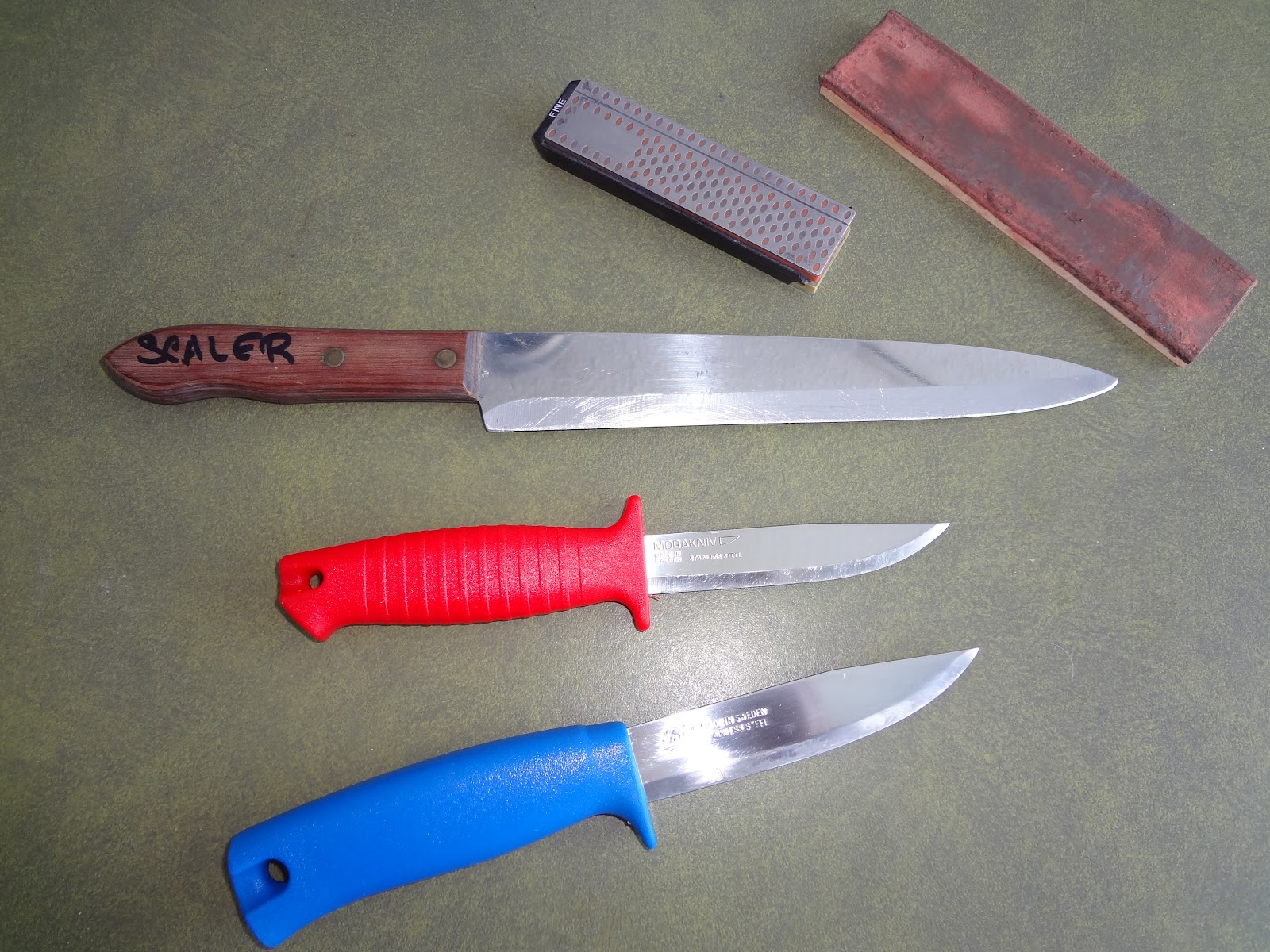
I fished from 10:00 to 11:30 pm then took an hour nap, awoke, ate a snack, drank some coffee and continued fishing until the first hints of dawn broke over the eastern sky.  Landed some speckled trout; kept the legal ones and let the others go.  In between I filleted my keepers with a couple of new knives I acquired recently from el señor Ragnar at Ragweed Forge.  Neither knife is what you’d call a bona fide fish filleting knife.  One knife is called The Craftsman and the other the Sports Knife.


The Craftsman is a basic stainless steel Mora knife with a 4 1/8 inch long blade that’s .079 inch thick.  The handle is robust with a very slight guard.


The Sports Knife is also stainless steel and smaller than the Craftsman with about a 3 ¾ inch blade that’s .078 inch thick.  The handle is shorter and it comes in various colors.  It has a distinct double guard and this feature actually comes in handy when filleting slimy fish.  You’ll note this knife also has a pronounced “sticker” or clip with a sharp point.

But these knives are designed for other chores and as such some people might suspect they make poor filleting tools.  Well, yes and no, I guess.  The Craftsman is perhaps a bit too bulky for proper filleting but the little Sports Knife does a good job.  At least it did a good enough job on what I caught and the knife took less than fifteen dollars from my wallet.  Buy a “proper” fillet knife and you’ll spend twice as much.  That’s no big deal unless you ask, “Do I really need more?”  That’s something you’ll have to answer for yourself.  I weighed the pros and cons and, at least for now, am content with both knives…favoring the Sports Knife somewhat over the Craftsman.  My only critique is that I don't care for the term “sports knife.”

Dawn appears beyond the bay not in sequential steps but as if a switch was abruptly flicked.  The first light is nothing more than a hint of change.  But it does not come on gradually.  You look and a second before it was pitch black and now you notice color—an anemic pink with hints of orange and if you had not paid attention you would not have noticed.  It is simply not there one second and there the next.  From the boat docks about a mile to the south comes the first noise.  Judging from the noise you’d think a race was on.  And so the quiet is gone and will stay gone until all “the sportsmen” have buzzed about racing from one point to another.  Then the night will return and they will party or drive home and be happy or disappointed depending on whether they caught fish or not.  Much camaraderie, a toast and then another to success or failure or for no reason at all.  Let’s race over there and then over there, and when the sun disappears they do too.  So I will walk the long pier and sit and take possession of the night.  Listening to seagulls chirping and waves sloshing, and thinking about things in particular and nothing in general.  The hours slip by like schools of fish coming into the light.  Last night it was speckled trout.  Tonight it will be red drum.


Saturday, May 26, 2012

French Bush Hat


Back in the mid-1980s a catalog arrived from a mail order firm calling itself “Banana Republic.”  After a few pages perusing the booklet, I was smitten.  The catalog had all the kinds of stuff I like.  There were classic khaki pants, a neat photojournalist vest, a gear bag to beg for, heavy cotton shirts styled like the ones Gable and Grainger wore in a couple of African safari films, and there was this heavyweight cotton hat with a large brim called the French Bush Hat.  Now years before in an army surplus store I’d seen a hat that looked exactly like the one in the catalog.  The hat was in a bin filled with all sorts of WWII paraphernalia and when I saw it I thought, This is perfect for the Texas Brushlands.  The only problem was the hat was too small for my head.  I’ve always had a hard time finding hats that fit and even XL sizes are sometimes tight.  The hat in the surplus bin was a size Small.  I was disappointed but after looking through all the bins to see if per chance I could find a size XL I gave up and until that catalog arrived had not thought about it.


Apparently, this particular style of hat was used by French forces in Indochina during the late 1940s.  It might have been employed in other campaigns as well, but this is not a historical piece so let’s talk about the usefulness of this hat for places where the sun is fierce and the days are long.  I ordered a French Bush Hat and the first one that arrived was marked XL but it must have been made for Lilliputians because it didn’t fit.  I returned the hat and Banana Republic apologized and said they were getting another shipment with sizes more appropriate to American heads.  About a month or so later I ordered another hat and the one that arrived was perfect.  Traditional khaki with a heavy mesh burlap inner layer, the hat was simple yet elegant and timeless.  So, of course, I ordered two more.  Now I wish I’d ordered ten more!  That was 26 years ago and I put one hat and then the next through several thousand miles of sun, wind, dust, thorns, rain (it does rain here occasionally), and now I’m on the last of the three.  Actually, this third hat alone has journeyed across deserts, mountains, jungles, forests and of course brushlands too.

Unfortunately, the hat I have—the official Banana Republic French Bush Hat I bought decades ago—is as endangered as the Texas Horned Lizard.  Ebay has a French Bush Hat now and then but they are invariably Munchkin size.  You see, somewhere along the line Banana Republic morphed from the great adventurous mail order house it was into just one more mono-dimensional and boring shopping mall store.  Just like several hundred other mono-dimensional, boring, yawn, yawn, yawn….


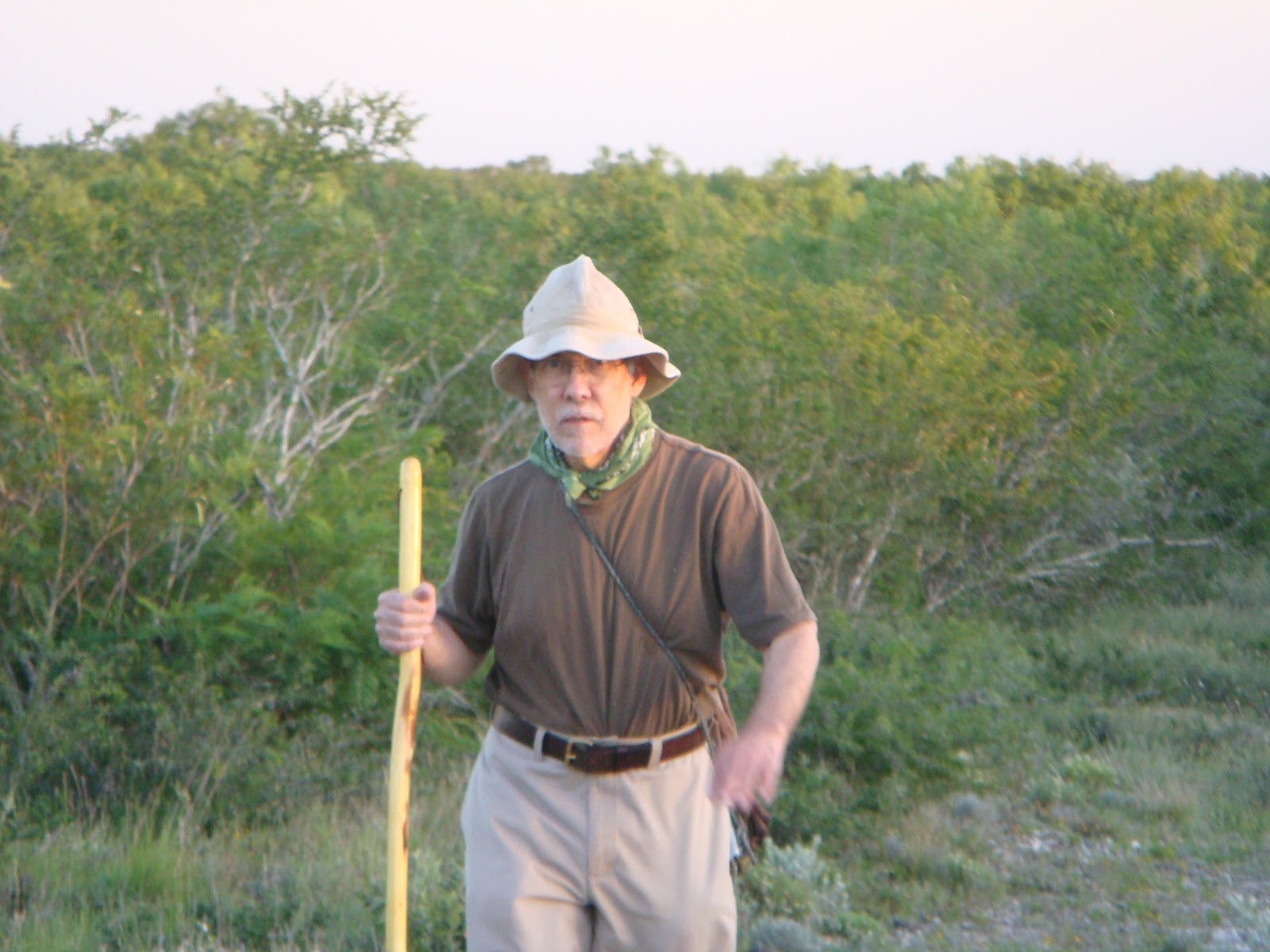
So here I am doing my best to keep this ol’ threadbare rag of a hat alive though I fear its days are numbered.  Too bad some entrepreneur doesn’t decide to resurrect something paralleling the hat in the photos.  The heavy-weight burlap mesh acts as insulation much the same way that an ice chest keeps its contents cool even on the hottest days.  Remember this isn’t a thin piece of gear but a stalwart defense against el sol.  Even so, the cotton breathes and the three-inch brim keeps the sunlight away from the eyes, ears and nose.  Remember too that nothing suggests an impending case of skin cancer better than those gimme-caps you see a lot of folks wearing these days.  Fashioned after baseball caps, I guess, they do nothing to protect the ears and the side of the face from sunburn.  By-the-way, the ears are extremely sensitive to sunburn and if you ever see a dermatologist that’s the first place checked when examining your head for signs of cancer.

Maybe somebody knows of a source for these hats.  If you do then send me an email and I’ll share it with everyone else who visits the blog.  These are darn good hats!