Friday, May 30, 2014

What a Hobo Camp Can Teach You About Bushcraft If You're Willing to Learn


A man needed a job but none were available locally.  So he hopped a train and went in search of work.  No one is quite sure where the term, hobo, comes from but regardless it first appeared around 1890.  During hard economic times like The Great Depression of the 1930s and on other occasions as well men rode the rails from one place to another in search of gainful employment.  They’d make camps along the way often in secluded and wooded areas where they’d hopefully be left alone.  Maybe scrounge up a meal, a cup of coffee from some well-used grounds, a bath in a nearby stream, and then a night sleeping on a blanket carried over their backs.  It was a hard life though as often happens some things get romanticized.  I never talked to a hobo but I sure saw them when I was a kid.  You see, we lived a block and a half from the railroad tracks.  We weren’t poor but neither were we wealthy.  My dad was a bookkeeper at a gravel yard and we lived in a part of town surrounded by filling stations, beer joints and a couple of cotton gins.  I’ve written before that next door was a blacksmith shop and I picked up a few skills watching the smiths ply their trade.  A quarter mile away was a stand of thick brush.  My buddy Harry Cummings (who lived next to one of the beer joints) and I would venture out to the brush to hunt pigeons, grackles, and maybe spear a fish at a stream that fed into the town’s water pond.  Along the way, we’d pass the hobo camp.  Maybe it wasn’t such a good idea to get so close but both Harry and I were of the Huckleberry Finn mold with dads that didn’t take all that much interest in what we were up to or where we were going.  So be it.  We had great times exploring and luckily never got into any trouble.  Oftentimes when we crossed the tracks en route to the woods we’d spot a group of hobos at the camp.  But when the camp was vacant we’d drift over that way to inspect the place.  You can learn a lot about bushcraft and survival by examining a hobo camp—that’s if you’re an analytical sort, observant and curious.  Take cooking utensils for example.  A 15 ounce tin can makes an excellent coffee cup.  And an eight ounce can is perfect for backpacking if you plan on going light.  A one pound coffee canister makes a perfect billycan or a makeshift stove.  You can make a tent using a painter’s drop cloth.  The camp was never trashed up but things got discarded and Harry and I would check to see what the hobos were using.  Once Harry found a pocketknife but when he opened it one blade was missing and the other was broken.  Another time we found a slingshot made from a mesquite branch and an inner tube.  I was already a dedicated slingshot user but since my uncle was a medical technologist I obtained surgical tubing (We were way ahead of our time) for my slingshot bands.  Now and then we’d find the remains of somebody’s rabbit.  Maybe the slingshot we found was accidently left behind when the midnight freighter trudged through going west and the owner scrounged around for his shooter but couldn’t find it and was left no choice but to jump onboard and leave his getter behind.  Who knows?

The interesting thing about a hobo camp is you realize just what’s needed and what’s superfluous.  I’ve walked trails where people come along reeking of the local REI store.  “I’m carrying my titanium cup and my modular space-age tent, my beryllium collapsible walking cane replete with cellphone, GPS and miniature television.  Did I tell you about my hammock?  It’s made of a new hyper-catatonic-foam gel that radiates heat up from the ground and at the same time circulates cold air over the top.  Only four hundred and fifty dollars plus tax.  Oh yes, allow me to show you my flashlight.  This thing is awesome.  It actually has a memory device that records what you just observed a minute ago in case you want to relive the moment and it was on sale for three hundred and thirty…..”

I get a kick out of the YouTube videos where people take a Heineken beer can and make a stove or find an empty can of green beans and use it for their coffee cup.  And how about the person who instead of watching Dual Superegos or Man Listening to Wife Complain or Naked and Starving instead goes out into the backyard and carves a kuksa.  Some of those ladies and gentlemen are real artists.  Thank you for sharing by the way.


Yes, that’s what those hobos taught me all those many years ago.  May their trails have been quiet and their camps nicely hidden.  Well of course, except for those two kids who looked like they were snooping around.  I can assure you they weren’t.  They were just searching for new places to hunt and fish.

Monday, May 26, 2014

The Logistics of Using a Walking Stick when in the Brushlands and Desert

The late Colin Fletcher who wrote books about backpacking and hiking once noted that he never felt a wilderness trek had begun until he’d cut a branch at the head of the trail for his walking stick.  I gathered that Fletcher was of the mindset that no self-respecting woodsman was ever going to use a metal pole.  Those collapsing aluminum jobs screamed tenderfoot.  But aside from that it’s important to know that a wooden stick taken directly on site is far less destructive on the environment than a metal or plastic rod that requires either mining or drilling to obtain the raw material, then manufacturing (using even more energy) and finally must be transported (still more energy expended) hundreds or thousands of miles to a store or online customer.  A walking stick taken in the brush, on the other hand, expends practically no energy because if done correctly the severed branch (never a sapling!) will be replaced by more branches shooting upwards.  The process is called coppicing and it’s a good way to insure a steady supply of walking sticks.

Retama Walking Sticks

I’ve become a firm believer in walking sticks.  In the Brushlands and Southwestern deserts of the United States a staff allows a woods roamer to not only maintain proper footing when ducking under low brush or tromping across rocky areas but it also lets the hiker probe the ground ahead for venomous snakes.  Around these parts I’ve made walking staffs from a number of hardwoods that grow more or less straight.  My preference is to use lighter woods but I’ve made them from chaparro prieto (Acacia rigidula) as well as guajillo (Acacia berlandieri)—by the way, it’s pronounced gwah-hee-oh—and from granjeno (Celtis pallida) and retama (Parkinsonia aculeate) and even a couple using mesquite.   My favorite are made from granjeno and retama and if forced to choose my most favorite it would be retama because when dried it is both strong and ultralight.  You’ll usually find retama growing near ponds or in low-lying areas while granjeno (gran-hen-oh) occurs commonly throughout the drier upland regions.


If a rattlesnake happens to be coiled up it will start buzzing when the stick makes contact with the snake.  In effect, the cane serves as a good alarm system.  But as well limbs can be quietly moved aside using the stick thus eliminating the need to use a machete to clear a path.  It’s for that matter that I seldom use a machete when walking in the brush.  Machetes at work are noisy contraptions that alert game (and people) for hundreds of yards all around.  A stick, on the other hand, is stealthy and efficient.

I cap my walking sticks with a piece of PVC.  One of the sticks was capped with some copper tubing.

I look for branches that are about 1-1 ½ inches in diameter at the base and are as straight as possible.  Remember that the top of the branch will become the bottom of the staff while the bottom of the branch will be the top or handle section.  You can use a Swiss Army Knife’s saw to cut the branch but it’s important to coat the ends with some type of sealant as soon as possible.  White wood glue is my preferred sealant but lip balm, mud or even the sap from a nopal cactus works fine.  Leave the bark on until the branch is completely dry.  This is particularly important for retama that cracks if the bark is stripped off before the wood has lost a majority of its moisture.

                                             A mesquite walking stick

I used to make walking sticks about 54 inches long but have since downsized to about 48-49 inches in order to negotiate thick brush.  I’ve got a friend who stands 6’8” tall and for him walking through any sort of thick brush is a real chore.  Regardless, he needs a walking stick even more than I do because constant stooping is hard on the back unless you can help support your weight with a stick.  He, of course, needs a stick about 54-56 inches long otherwise the staff is simply too short.  In other words, you’ll have to gauge your needs depending on not only the terrain you traverse but also your height as well.  I just completed a stick for a lady who stands 5’1” inches tall.  Made of retama the stick is lightweight and just long enough to suit her needs.  She has a friend who stands an inch taller and she asked me to make her a stick.  A few weeks ago I found a nice branch pictured below that will make an excellent smaller walking staff.

The retama stick above is now fully dried and ready to be worked.

Retama is green when first cut.

In years past we used to obtain “walking canes” at the feed & seed store but these canes were used to keep nervous cows from crunching legs and ribs in a corral.  We’d attach an aluminum sleeve along the base to keep the cane from snapping if perchance we needed to coax a cow out of the way.  When I was in high school I worked a couple of cattle ranches on the weekends.  A lot of cow punching is done on foot and not on horseback like some would have you believe.  And most real cowpunchers don’t wear those pointy-dandy-ay tĂș dejame sonso, high heeled jobs that you’ll see in drugstores and maybe on the dance floor.  No, real cow scramblers wear tough, low-heeled, sometimes lace-up or dingy leather pull-ups built to take abuse and keep the vaquero from busting his back if he has to vacate pronto.  All of this brings me to another job for a good walking stick.  I recall once upon a time being in a corral with three very grouchy bulls.  My buddy and I were afoot and we’d managed to “coax” each bull into separate corners of the corral.  It was a precarious situation but it was at that point that I learned a valuable lesson about bull control.  There were several long canes of Arundo donax stacked in the back of the corral and for whatever reason I no longer remember I picked one up and held it straight up in front of me and leaning a bit towards the bulls.  I guess the bulls figured that the crazy kid in front of them had all of a sudden grown one great big horn.  “Damn,” they must’ve thought.  So they kept back and from that point on I learned that if I walk up to an ornery bull or cow in the brush I simply hold my walking stick up high and, like before, the bovines back off.  That’s a good thing to remember when things get dicey.

Old time feed & seed store cattle pokers

A couple of old walking sticks: The one on the left belonged to my Uncle John Peters and the one on the right belonged to my grandfather Longoria.

The walking stick below was once used by a little four-year old boy named Matthew who would walk with his grandfather around the yard.  His granddad used a cane so Matthew decided he wanted one too.  So the old man found a branch and fashioned an impromptu stick for his grandson.  Of course, Matthew’s daddy has kept the little walking stick in his shed all these years even though Matthew is now 26 years old.  Memories, you know.


My dad’s walking stick made from guayacan root.


PS: Once you’ve made a good walking stick then don’t throw it away.  When on the trail you can examine your walking stick and think back on past trips.  A mark or scratch will remind you of former treks.  A good walking stick tells a story of past adventures.  So keep your stick and let the trails write their own stories on the wood.  And then when you’re seated in your living room and wishing you were on some secluded path you can pick up your walking stick and note a mark here or a scratch there and let those times flood your mind.  Memories, you know.

Thursday, May 22, 2014

The Therapy of Making Things

It’s important to learn to make things with your hands especially if most of your time is spent working with your mind.  Whether a doctor or engineer, a teacher or lawyer, and especially for those who spend long solitary hours at a computer building words in long chains that hopefully express complete thoughts.  Something entirely divergent from what you are accustomed like sculpturing or painting or perhaps building model airplanes or even making knives.  Let’s not forget things like crocheting or knitting.  I knew a stock broker who went home after work and weaved her own cloth.  Regardless, the activity must be something far removed from your regular work.  If you’re a metal fabricator, for example, and then you go home and make knives then that doesn’t count.  Perhaps you should try to learn computer programming or maybe baking.  It’s like learning to work your computer’s mouse with your left hand if you are right handed.  The object is to expand who you are and build upon it.  I see too many people who are wedded to the idea of purchasing.  I scan bushcraft forums where it’s nothing more than “I want this” and “I want that.”  It seems very few people know how to make things anymore.  Instead, they just want to buy.  This seems particularly problematic with younger folks who have grown up in a world of obsessive consumption.  But making things can be a form of therapy: A time to immerse one’s self in creating objects far removed from one’s daily life.

Here are a couple of new knives.


These are the last of this type of Woods Roamer's knives.  Now it's time to make other designs.  I've made dozens of crooked and hook knives and now a number of Woods Roamer designs including a few large full tang choppers.  I know what I want to make next and as time permits I'll build some entirely new designs. I did have a few visitors watching me as I finished these last two knives.


Some people say these monitos are made by an old lady who lives back amongst a stand of pine trees out of place in this desert.  The locals call it, “El Montecito” which means the little woods.  The old lady lives in an adobe hut thatched with reeds.  No one ever sees her because she’s always making monitos.  I think she favors pink and yellow but I’ve seen others roaming the woods in blue and red and once I saw two purple monitos.   As the story goes there lives a screech owl in an old mesquite that for some strange reason grows amongst the pines.  People say it’s a magical screech owl because it breathes life into the little monitos and allows them to wander through the woods.  I was busy working at my little shop finishing the two Woods Roamer knives pictured above when I spied this group of monitos watching me.  I had a camera and I approached them slowly and even as they saw me they did not move.  I snapped the photo then heard a mockingbird chirping loudly behind me.  I turned to look at the mockingbird and when I glanced again at where the monitos had been they were gone.

Saturday, May 10, 2014

Notes on the BP Security Machete in a Land Where Survival is Real and Plays Out Everyday


Security takes various forms depending on the situation.  For those who man the Southern Border of the United States as US Border Patrol the object becomes twofold.  Foremost is the job itself to safeguard the border from incursions related to illegal entry and drug smuggling as well as watching for those bent on gaining access into the country in order to commit nefarious acts.  It’s not a glamorous job and, despite the ongoing attempts by the BP brass to drum up publicity, most agents go about their work as it is perhaps meant to be: A job that allows them to spend a lot of time in the woods as well as a means to support their families.  You’ll never hear about agents becoming infested with pinolios or seed ticks when they tromp through nearly impenetrable brush along the Rio Grande nor will you hear about them walking up on six foot rattlesnakes in knee-high dry grass when in the upland brush.  And unless something goes terribly wrong you’ll not hear about them smashing their way into weed and coke-filled hideouts while keeping an eye out for gun totting bad guys.  This, of course, brings up the second object in the security equation: The need to protect one’s self.  The idea of protection however  is not one-dimensional.  A sidearm is imperative but should never be the only means of defense.  For that matter neither should a cutting tool.  A few weeks ago several Special Ops Border Patrol stopped by the cabin as they often do to examine my latest knives and learn a bit more about survival in the South Texas Brushlands.  I always look forward to their visits and it was on that occasion that I gave each of them granjeno walking canes with instructions to always keep them handy when cutting sign.  “Use these canes to probe the ground in front of you,” I said.  About ten days later one of the BP called me to say the cane I’d given him had saved him from a nasty rattlesnake bite on two separate occasions.  And so it was yesterday that a couple of Special Ops BP drove to the cabin to inspect my latest knife creation as well as talk brushland survival then later have me accompany them to cut sign through a large patch of stubble grass, sun-burnt shrubs and fine-particle sand.  This, my friends, is a sign-cutters worst nightmare.  Even over rocks a good tracker can spot idiosyncratic anomalies that indicate where people have traveled.  But on fine-particle sand (especially when the wind is blowing) tracks become obliterated in as little as an hour.  It’s also difficult to tell exactly how old a footprint might be since even fresh tracks on fine-particle sand appear old if compared to tracks seen on other types of soils.  We’d had an incident the day before when two women and a man walked up our driveway scared and defeated.  They’d been wandering through the brush for four days with nothing but a couple of bottles of water (now empty) and three cans of peaches (two of them already consumed) and all they wanted was water and for me to call the Border Patrol to come pick them up.  Now listen up all you survivalist wannabes who love to talk about the latest character changes on those amateurish TV survival shows and who wouldn’t last ten days in the woods if it were the real thing.  What I witness out here is genuine survival!  I see it on almost a weekly basis.  I encounter people who have faced extreme conditions, some of them for up to a week walking in temperatures as high as 110 degrees Fahrenheit with little to no water, with no backpack full of gear, with no knife, no matches, no food, and no flashlight or ferro rod.  I find them panicked and sick.  I find them disoriented, gone crazy from lack of water.  I find them wild-eyed and in shock.  And I find what’s left of them after they succumbed to the heat and their tongues swelled up to where they could no longer talk or even breathe and they collapsed on sunbaked sand and lapsed into unconsciousness; and hopefully they died quietly because when night came the wild hogs sniffed their scent and by morning all that’s left is a scattering of blood-red bones.  By noontime the buzzards have finished the task of sweeping away any vestige of who they might have been.  The three folks who walked up to the cabin even as the dogs barked furiously were nearing the end.  The older woman was suffering from acute dehydration.  Her 14-year old daughter was scared though in better shape than her 39-year old mother.  The 27-year old fellow with them was weak and disoriented.  They were weeping and pleading for water.  “Please call la MigracĂ­on,” they said.  So I called the Border Patrol then asked them to sit under a mesquite tree while I brought them water and some peanut butter sandwiches.  I knew it would take an hour at least for the BP to make it out to my place so we began talking about what they’d just gone through as well as their long journey across parts of Central America then through Mexico and ultimately to the ranchlands along the South Texas desert known as The Sand Sheet.  I’m saving that talk for a book I’m working on about this life I live since the telling would be too long for a blog post.  When the book comes out I think you will find it interesting as well as informative.


Yesterday when the Special Ops fellows were here they wanted to look at my knives as always.  When I showed them my two latest machete choppers pictured in this post one of them said, “Arthur, now you’ve got to let these go.  This is what we need.”  I smiled and then shot them a price and he said, “Done deal.” To which I countered, “Okay, let’s try them out on that mesquite over there.”  So in 95 degree heat I had two young fellows whacking away at the mesquite and then a brasil that needed pruning.  And that was that.  I’ve been asked to make some more of these heavy machetes.  And so I will.


These are robust, full-tang machetes designed for cleaving whatever needs to be cleaved—and again we’re talking situational scrutiny here.  They are ultra-sharp with shallow convex bevels.  Made from 5160 leaf-springs they are differentially tempered with three different Rockwell hardness calibrations at the bevel edge, the spine and at the juncture of the handle.  The scales were epoxied onto the ¼ inch thick tang then pinned with brass.  The blades run 10 ¾ inches long and the dark machete’s handle measures 5 ¾ inches while the antiqued machete’s handle measures 6 9/16 inches.


The three who had survived four days in the desert were in remarkably good shape considering the ordeal they’d just been through.  But these are people who are used to hard times, accustomed to living without many of the niceties Americans and Europeans take for granted.  In other words, they’re tough.  Besides, they’d never do anything as foolish and downright stupid as troll the backwoods or deserts butt naked.  But then again neither did they have a film crew within feet of them ready to whisk them off to a comfy bed and nice meal.  Like I said, this is true survival.  But lest anyone think romantically or foolishly regarding these scenarios let me add that the issue, especially here on the US/Mexico border, is complicated.  Homesteaders, particularly those living within a few miles of the Rio Grande, are robbed, their buildings are raided, mounds of trash liter their properties, and many of them live in fear of who might be lurking in the woods near their houses.  We too have had things stolen and on a couple of occasions people arrived who would obviously take us down if they got the upper hand.  Guns, dogs and knives don’t play trivial roles in these parts.  A New York-based TV production team doesn’t stand by to catch everything on film.  Yes, we’re opinionated and look on people who proclaim they’ve got “twenty years of expertise teaching survival” as neophytes.  We’re not all that impressed either by anyone who comes along and says he was a former sniper or tactical Army guru in the Middle East or some such nonsense.  No, this ain’t Hollywood and we keep our clothes on and live quiet lives or at least try to keep things tranquil.  This coming week the Border Patrol will show up to talk knives and ask questions about survival from an old man who’s spent most of his life in the woods.  We’ll swap jokes and they’ll want to see some selfbows and river reed arrows.  Questions on Intel; and even small talk about family and how my dog that got bit by a rattlesnake a few weeks ago is doing.  I’ve got more requests for walking canes and I’m happy to give the BP what I’ve got.  I guess I’ll get more requests for heavy machetes too.  But that’s going to cost a few nickels.


Sunday, May 4, 2014

Duraznillo: South Texas Wild Peach


Paleolithic people living at the edges of the South Texas Sand Sheet as well as the southern Texas coast knew that springtime was the season for duraznillo.  Eaten ripe off the bush or made into a jam the little peaches provided a tasty treat and a healthy diversion from the nopalitos and mesquite beans that were usually harvested around the same time.


Here at the old Woods Roamer’s hideout we’ve got duraznillo growing in clumps within a few yards of the cabin.  But getting a taste of the sweet fruit is rare.  You see I’ve got competition.  Mockingbirds, thrashers, woodpeckers, pyrrhuloxias, the list is long and hungry; and they usually feast on the fruit long before I get a chance.

Duraznillo flowers attract scores of important pollinators

If I’m going to get a morsel then I’m usually forced to harvest the duraznillo green so I time my pickings to just before they begin to ripen.  Now nothing beats shrub ripened fruit and a couple of times in the last few weeks I chanced upon a bush loaded with fruit with a few of them ripe.  I’d pick them and eat them.  But there were never enough to make jam.  The next day I’d go out to see if the little peaches were ready but they were always gone.  Time and time again this happened.  I guess I could build a shelter around several shrubs (a sort of greenhouse) and then have all the fruit to myself.  But then those of you who follow this roaming into South Texas nature and bushcraft know I’m also a dedicated bird watcher.  So I’ll sit somewhere close to a duraznillo bush, binoculars nicely focused, and watch birds munching and singing and talking up the feast.  But wait, there’s more!  A year later there’ll be many more duraznillo shrubs growing under places where the birdies perched after gorging on the little peaches.


Can you spot the bird's nest?

Family: Rosaceae
Scientific Name: Prunus texana
South Texas Common Name: Duraznillo (Little Peach)
Pronounced: Doo-raz-nee-oh

Friday, April 25, 2014

PART TWO: Replacing the Plastic Handle on a Malaysian Parang

The traditional Malaysian parang comes with a wooden handle.  The handle is sometimes sloped with a flare or bulbous end that helps maintain control of the tool when chopping.  Some handles are well made while others are crude and poorly conceived.  Plastic handles have replaced wooden handles in many models—particularly those found in hardware stores and other shops.


Bidor Parang with plastic handle

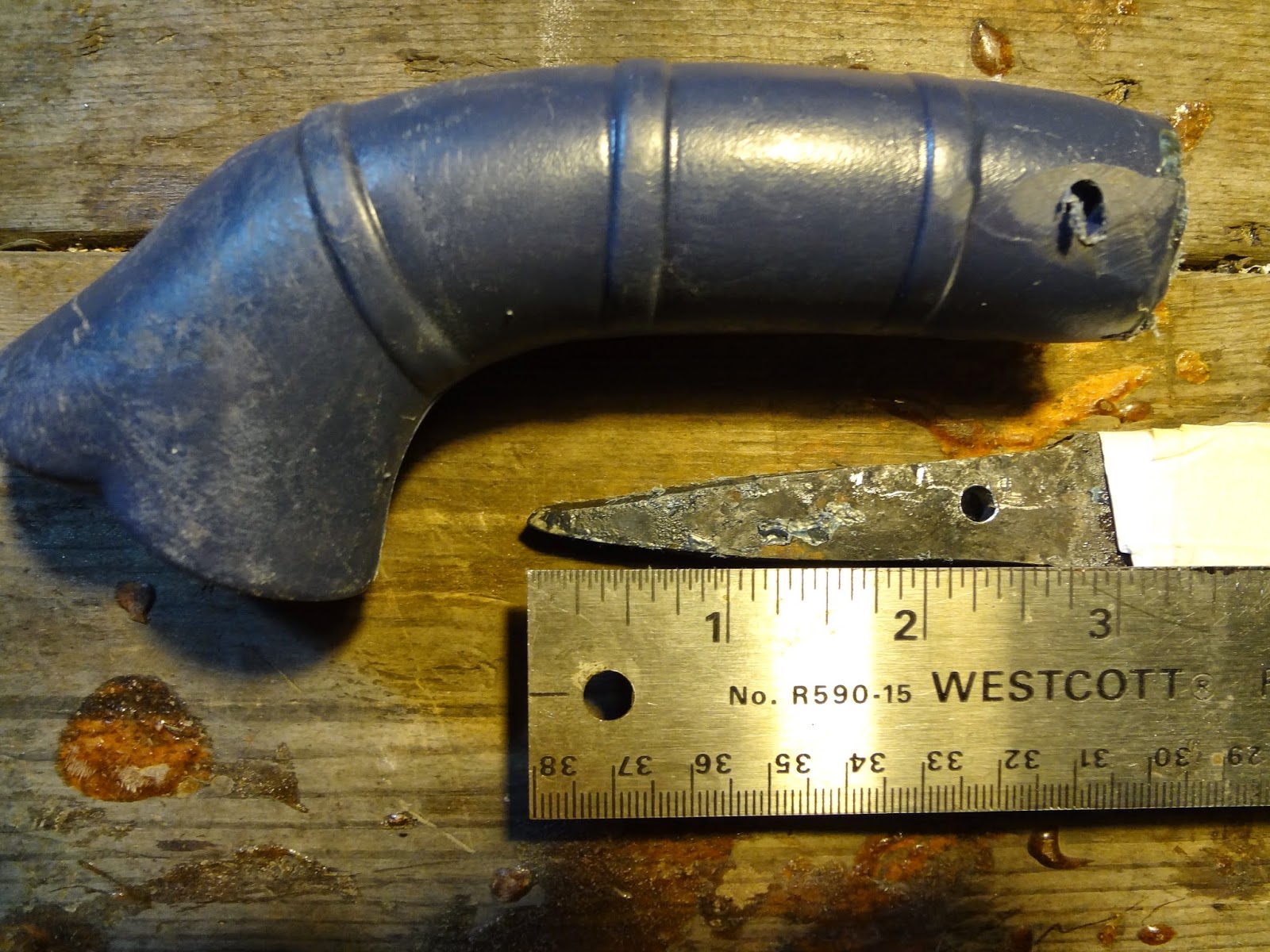
As detailed in the previous post the handhold section of the plastic handle is about 3 1/8 inches.  The overall handle length is 5 3/8 inches.  Using my Bidor parang for general brush cleaning and assorted bushcraft endeavors around the cabin proved uncomfortable as a result of the small handle and I soon relinquished the parang to storage.  After a while, however, I decided to replace the plastic handle with a wooden handle that mimics the handles I make for my Woods Roamer knives and larger choppers.


The new handle is made from mesquite.  It measures 6 5/8 inches long and incorporates a 3/8 inch long copper ferrule at the fore-section to support the parang’s stick tang at its widest part.  The handle’s circumference increases from fore to aft.  This allows the user to choke the handle nearest the blade when performing detailed woodcarving tasks.  The end-swell helps control the knife during light chopping.  I also rounded the steel nearest the handle to allow the user to grab that section more comfortably.  (Refer to photo)  Most of my Woods Roamer knife handles range about six-inches long but I decided to go a bit more on this knife  My biggest concern, as noted in the previous post, is the short and somewhat flimsy stick tang used on these parangs.  Honestly, I don’t believe I’d want to trust my life to this parang.  The tang, measuring only 2 7/8 inches long, is simply too insubstantial for any genuine survival use.  We should remember, however, that Malaysian parangs are made by villagers or in small shops and sell for a few dollars, a price well within the affordable range for rural customers.  Malaysian parangs were not designed for foreign markets nor were they intended to suit the needs of urban bushcrafters or survivalists.  They are inexpensive, quickly replaceable tools made from recycled steel and as such fit the needs of Malaysians—if not the needs of bushcrafters who end up paying from five to ten times (in the US or Europe) what the knife is actually worth.


Allow me to analyze the parang’s stick tang and its typical handle a bit more.  The stick tang is placed within the wooden handle via a hole drilled and filed directly into the wood.  As a sidebar let me add that on a YouTube video a Malaysian acquires a piece of green wood and then begins tapping a sharpened stick tang into the wood driving the sharp tang downward until it is fully inserted into the wood.  Apparently no cross-pin is used to help hold the tang in place.  The wooden handle (with the blade now attached) is then placed next to a fire to allow the wood to dry.  I think any knifemaker will look at that video and shake his head.  First, as the wood dries around the stick tang it will shrink in size and thus pull away from the tang.  This will loosen the tang within the handle.  Second, placing the blade so close to a fire creates the potential for destroying the steel’s temper particularly as heat travels up the blade towards the cutting edge.  In other words, this video serves as a good example of people doing things with little to no knowledge of either wood or steel dynamics.  Now let’s continue: If you drill a hole into a piece of wood you are weakening the wood’s strength around the hole.  The extent to which you weaken the wood depends on how deep the hole is drilled.  As an example, a short tang, as seen on Malaysian parangs, drilled under three inches does less damage than a five or six inch tang might create.  In that sense, the short stick tang, as seen on these parangs, works okay as long as we acknowledge that the concept is a compromise.  In other words, it works given the needs of those who use it.  If one intends to use a longer stick tang then I suggest instead of drilling a hole, one should cut the handle in two and then carefully inlet the tang into both sides (or scales) and then pin and epoxy the three parts (two scales and tang) back together.  This makes for a stronger handle since the tang is mated firmly (via inletting) into the wood with no void of any sort.  Note that the hole drilled into the wood to insert the stick tang in Malaysian parangs is often filled with epoxy.  This is good but not necessarily as strong as direct contact with wood as seen in proper inletting.  Let me add that one should avoid the urge to simply drill a large hole into a piece of wood in order to drop the stick tang into the hole and then fill the gap with epoxy.  That will not make for a strong core even when pinned.


I triple pinned this tang.  One pin is underneath the copper ferrule and two other pins are directly behind the ferrule as seen in the above photograph.

When I see pictures of Malaysian parangs I come to one of two conclusions.  Either I’ll think, “This fellow knows knife design,” or I’ll think, “This guy is a novice.”  I saw a post a few years back where a guy makes a handle for his parang.  I liked the way he carved the handle with his Mora knife but otherwise the finished product failed ergonomically.  I think the man even admitted that fact in a later post.  Good for him.  First of all, if you want to make a new handle for a parang you should find a branch with a natural curve and start your handle from there.  Don’t simply get a chunk of wood or a big, round branch and attempt to make your handle—unless the wood is big enough that you have enough to work with to form a sloping handle.  Also, some of these Malaysian parangs have a bulbous belly that despite its intentions crowds the hand, interferes with chopping and does little to keep the blade controlled.  If you want to see how a handle ought to be designed then please refer to the handle I made for this parang.  There is nothing original with this handle.  As mentioned in the previous Part One section of this post I am simply copying the handle of the great Colt Peacemaker that in my opinion is the most comfortable handle ever designed on any “working tool” bar none.  The Colt’s handle rolls with the recoil and thus does not bury the grip into the hand.  The handle on this re-worked parang does the same thing.


So there you have it, folks.  Will I use this parang now?  Of course, I will.  But I will use it knowing its limitations.  I am amazed at the videos I see where people take parangs even kukris and start chopping huge branches.  Hint: Use an axe!  The parang is designed for rainforest use especially in places with bamboo.  It works quite well in the desert Southwest and Brushlands as a bushcraft tool.  Machetes with longer 24-inch blades work as well if not better most of the time.  The parang’s short tang is decidedly disconcerting and every time I examine my Bidor parang I use my X-ray vision to see that tiny little bitty tang underneath and I think, “Hmmm, I wonder.”

Monday, April 21, 2014

PART ONE: Replacing the Plastic Handle on a Malaysian Parang

Most people think of the Malaysian parang as a short and somewhat portly machete.  But that description is misleading because parangs come in different styles with varying blade lengths, width variations and contours.  Depending on the locale a parang’s blade is either straight or curved upward or it might have a distinct angular cast near the handle that sweeps outward into the blade proper.  There is, therefore, no archetypal parang pattern with the exception of two design elements, one of which remains unseen and the other is a product of its manufacture.  Allow me to address the last element first.  Unlike machetes that are mass produced in large factories and buy steel from mills in significant quantities, the Malaysian parang is usually derived via a cottage industry.  In other words, villages may produce parangs for their own needs or in some instances a small shop might be set up with several bladesmiths to produce parangs for sale.  Regardless, the steel used for most parangs comes not from wholesalers but the junkyard.  That’s not to suggest that parangs are of a lesser quality than Latin American machetes but instead one might infer that the parang serves as an excellent example of metal recycling.  Typically, the parang maker seeks out leaf-springs made from 5160 steel and then forges them into shape.  This steel by-the-way produces a robust blade that, if heat treated and tempered properly, makes an excellent backwoods or jungle tool useful for everything from chopping small hardwoods to butchering game.  As such, the parang has become a sought after survival tool in regions where the blade design compliments the environment.


I purchased a 12-inch blade parang about a year ago because I wanted to examine the parangs manufactured at a shop in the town of Bidor, an industrial and farming community in the Batang Padang district of Perak, Malaysia.  I’m not sure what type of steel is used on the Bidor parang but I suspect these semi-mass produced parangs are not made from leaf-springs and may not be 5160 steel.  Perhaps someone will comment on this for us if they have further information.  The Bidor parang is not particularly heavy and on average the blade is about 4-5 millimeters thick at the rear tapering gracefully to about 2-3 millimeters at the blade tip with most of the blade in the 3-4 millimeter range.  The blade is of a type popularized by British survival expert Ray Mears who uses a parang in many of his BBC programs.  Mears parang looks to be handmade and is shaped slightly differently at the tip but that variation is of no consequence and is merely an aesthetic interpretation.

Here’s a quick note about this type of parang shape: When a piece of flat bar stock steel or a vehicle leaf spring is heated and then pounded on an anvil it begins taking a crude U-shape.  Therein lies the parang’s silhouette and the knife maker need only square off the tip or round it off and then either cut out a handle or, as in the case of the Malaysian parang, make what is called a stick tang.  Which brings me to the second design element—the one that remains unseen unless one removes the handle.


When my Bidor parang arrived I did what most knife aficionados do and that was to give the knife a thorough inspection.  I examined the blade noting the types of tools used in its making.  After having made quite a few knives I can look at a blade and tell you if an angle grinder, belt sander, hand file and even a Dremel tool was used in its manufacture.  Mind you the Bidor parang is a classic Malaysian working tool and as such not meant to be cute or fancy or as a fellow I know puts it, “Made for the mirror shiny bunch.”  The blade is painted black to protect it from rust, and tooling marks are left where they fell.  There is the “mirror shiny bunch” and then the parkerized, covert, stealth bunch.  You can include me in the latter group as I’ve never liked shiny knife blades.


When the stick tang was finally unearthed and measured I was surprised and a bit in disbelief.  The tang is 2 7/8 inches long and is only ¾ inch wide at the front or nearest the blade.  Now reason, logic and physics tells me that is way too flimsy.  But then who am I to argue with Malaysians who have employed this tang style for a very long time apparently with great success and few failures.  Even so, when I make a stick tang for my Woods Roamer knives and Brushland Choppers I have a tang that’s from 4 ½ to 5-inches long and does not taper as radically as the Malaysian parang.  It just gives me a bit more confidence when I use the knife but without disturbing the overall balance.


The actual hand-hold section on the plastic handle is a tad over three-inches before melding with the curved down swell.  That's far too short in my opinion.  Every time I used the parang I was frustrated and after a while I relegated the blade to what I call, “The Box.”  That’s where I keep a lot of blades.  But last night I was not in the mood to be inside nor was I very sleepy so I went out to the shed with camera in hand and the Bidor parang.  Within a few minutes the plastic handle was gone and I set out to make one with a more comfortable handle.  A few days ago a mean-spirited north wind blew a small mesquite tree down near the cabin and so with pruning saw in one hand, a flashlight in the other and a pistol in my back pocket I set out to cut a branch from yonder fallen tree for my new handle.  Now mind you that walking out in the dark searching for a suitable parang handle is crazy.  One must always be looking out for rattlesnakes and then when sawing off the branch it’s unwise to grab things without inspecting them for pamorana ants and scorpions.  Even in my little shed I’ve got to watch constantly for scorpions, centipedes, and the occasional rattler that will slither in looking for a meal.  Trick to it is sit on a high stool with feet off the ground and when a fat wind-scorpion, regular scorpion, giant centipede or ill-tempered rattlesnake comes to visit then watch and wait.  I usually kick the wind-scorpions out and step on the regular scorpions.  Best let the centipedes go their merry way because those things are nasty.  As for the rattlesnakes: Take a guess.


To make a new handle one needs a piece of wood, a ferrule (I’ll be using a ¾ inch copper tube that’s about ¾ inches long) and a couple of brass pins.  When I removed the plastic handle I drilled out the cheap nail that the manufacturer placed as a pin and opened up the hole a tad.


Regarding handle design: First of all, the best handle for any sort of chopping blade is one with a graceful curve that allows the hand to shift comfortably as the blade is used.  Think of this along the lines of the great Colt Peacemaker handle that rolls during recoil.  I examined several branches looking for just the right shape and at last found a section that I could use.  I took several measurements then using a hand drill made a hole about three inches into the wood.  I find that for me the ideal handle length is about 6-inches long.  The handle on the Bidor parang was only 5 3/8 inches long overall.  Using a series of round rasps and files I carefully opened the hole until the parang’s stick tang was set to the desired depth.  Now I’ll wait a few days allowing the wood to dry a bit before I continue.  Stay tuned, folks.  Part Two will arrive in less than a week.