Sunday, February 23, 2014

Comments and Emails Related to Global Climate Change Post....

Thank you for taking the time to comment on the previous post pertaining to global climate change.  I’ve received dozens of emails in addition to the published comments.  Many of the opinions have been from people telling me horror stories about how their land and the air they breathe have been polluted by one industry or another.  Unfortunately, the topic of Global Warming or Climate Change or as I like to refer to it, Chaotic Climate or Climate Related Mayhem, is both contentious and sometimes difficult to dissect.  The polluting industries and their comrades including the Rightwing Media have spent millions of dollars attempting to distort the issue and muddle the available data.  They realize that if the public opts for prudent and rational behavior then their abilities to profit at the expense of the land will be greatly diminished.  In the end, this is less about a cleaner environment than it is about a small group of people continuing to reap great profits while destroying the planet.  In the clinical sense their actions would be defined at the very least as “hyper-instrumental” in that they will use anyone or anything as an instrument to get what they want with no feelings of guilt, remorse or anxiety.  In its most extreme form it is called sociopathology.  But ask yourself: Isn’t it better to have clean water, breathable air, genuine forests (not tree groves), and a landscape that isn’t choked with toxins and carcinogens?  If we can work towards those goals then the topic of global climate change becomes moot.  It is, after all, our continued desecration of the earth that has raised these broader issues.

I received emails from people who have experienced the terror of living in areas where intense gas well drilling is occurring.  One correspondent from the town of Hebbronville, Texas said that parts of the town have a nauseating smell as a result of the drilling.  He said that an area to the west near a small town called Catarina is also enduring the effects of both toxic air and polluted subsurface water from hydraulic fracturing or “fracking.”  Another letter was from a lady who said her husband’s COPD was greatly exacerbated by the air pollution in the city where she lives.  She added that she has become active in educating others about what polluted skies do not only to those suffering from respiratory diseases but also to children with developing lungs.  One particularly poignant email came from the great state of West Virginia where a company called ironically “Freedom Industries” spilled two extremely toxic chemicals into the Elk River and poisoned the drinking water for about 350,000 people.  You might recall the CEO of Freedom Industries appearing on national television replete with a bottle of pure drinking water and complaining that it had been a long day and he was tired and (swig, swig) he just wanted to go home.  It reminded me of the CEO of British Petroleum (BP) who during the devastating oil spill in the Gulf of Mexico where millions of people were impacted and great swaths of shoreline were forever damaged and eleven men lost their lives said that he “just wanted to get [his] life back.”  Both of those men are prime examples of hyper-instrumental behavior.  In the email the writer from West Virginia said that her family has been shattered by the leaking poisons and that they fear many of the local residents might have to eventually relocate.  In other words, they have possibly lost their homes.

For most of us who meet at this blog-site the central issue revolves around our ability to enjoy nature.  Whether we are bushcrafters or birders or native plant aficionados or all three combined we share a deep connection to the land and to preserving the wilds.  Thus anything that threatens our love for nature also threatens us both as individuals and as a collective group.  We don’t just sit idly by as the land and the air is polluted by those who could not care less about nature and whose sole motivation is to profit at the expense of others.  Judging from the letters and from the friendships I have made through this blog I gather that we are all very much the same and that most of us are active in the cause of saving the land, the water and the air we all breathe.  In other words, when others destroy the natural world then they are in effect destroying us.  And that is why we are passionate about topics like clean water, unpolluted skies, and diverse natural habitats.  We revel at the sight of a bird or when we hear it singing; we are filled with emotion upon looking at mountains in the distance; we hunger for quiet walks in the forest; and we are appalled when others speak of bulldozing a prime patch of nature or when we see where callous and selfish people deliberately poison our underground water supplies and fill our skies with contaminants.  And perhaps most of all—judging from the comments and emails I’ve received over several years of blogging—we are not of the type to just sit back and be victims.  Yes, it seems that those of us who gather at this blog-site are fighters each and every one.  So please let’s keep the dialogue going.  I enjoy reading your opinions whether in the comments section or in emails.  Discussion is the key to understanding and analysis.
Thanks,

Arturo Longoria


Friday, February 21, 2014

Chaotic Climate January 2014

If you’re locked in a freezer that’s set in the middle of a sweltering desert then you might assume there are no problems regarding an ever warming environment and its associated chaotic climate.  That seems to be the attitude of some people who, based on their local weather, have concluded that warming temperatures are a myth.  So let’s call this phenomenon, “Locked in a Freezer Syndrome” because as the following data shows, this past January was hotter than normal worldwide.  As such we might expect blizzard conditions in parts of the world where significant amounts of evaporation off our ultra-warm oceans waft to places where it gets dumped as snow.  That scenario is entirely within the parameters of chaotic climate theory that is now, by the way, even more supported by the data.  No, Uncle Wilber, it’s not a hoax; and no Aunt Molly, it’s not a conspiracy; and no Cousin Billy it’s not a secret plot to “take away our rights.”  It is simply data—supportive data—that keeps accumulating showing we can expect more and more chaotic climate incidents.  Take Australia and the US state of California for example.  Both places are suffering from extreme drought—which, of course, leads me to question whether Australian born plutocrat Rupert Murdoch ever checks the weather reports Down Under.  Seems Murdoch enjoys disseminating poorly thought-out and data-deficient pronouncements denying chaotic climate and the ever-growing mountain of data suggesting its human related causes.  But for Murdoch and all the others who have failed to look up the data then perhaps the following maps will, if nothing more, raise an eyebrow or two.


What the above maps show is that despite sections of the earth that have experienced blizzards in the past few weeks the overall picture still shows a planet in the throes of increasing record breaking temperatures that just keep going up and up.

Ah, yes.  I can hear the naysayers even from my enclave in the deep woods.  I recall the old song, Love Hurts (I preferred The Everly Brothers version).  Maybe it’s time for a new song, Data Hurts.

For More Info check out the following website:

Tuesday, February 18, 2014

The Last Vestige of Christmas...Tasajillo Cactus

I look forward to Christmas.  Temperatures drop or at least they dropped this year.  We had a decent winter which is something we’ve sorely missed over the past decade.  For those of you to the north I think I have a bit of good news.  A couple of nights ago I was making a set of arrows in my little hobby shop and two flights of Canadian geese flew overhead going north.  A sure sign that winter is coming to a close.  In Deep South Texas winters are short-lived and over the past decade they have been practically non-existent.  Our worldwide chaotic climate has given us some years when temperatures never went below fifty degrees and if they did it lasted for only a few hours.  But this year we had a good winter and I am thankful for the respite from the heat.  There will be days this coming July, August and September when temps will soar well above the 100 mark and I will think back fondly on this winter.  A couple of weeks ago I was in North Texas in twelve-degrees of snow and ice with a wind-chill of zero.  It brought back memories of my days in Michigan long ago when I’d hike out over a frozen Lake Michigan and sit on hillocks of ice to enjoy the quiet.  By the way, I was told that it’s been a long time since the lake has frozen over.  Apparently, this is the first time since the 1980s that at least 75 percent of the lake has been covered in ice.

Already things are returning to normal around here and the cold-fronts are becoming sporadic and not very intense.  But all around are vestiges of this past Christmas and when the sun is setting the Brushland lights up with its own glitter.  Perhaps the woods is as reluctant as I am to let go of the beautiful Christmas of 2013.


We call the plant pictured above tasajillo (tahs-ah-he-oh) but it is otherwise known as Desert Christmas Cactus.  I prefer the name tasajillo because it’s an older name to the region.  One of my objections to many plant field manuals is that they fail to include the oldest common names for the area covered.  Thus in South Texas most field manuals would be, in my opinion, more instructive and accurate if the authors always sought to name a plant using common names of Native American or Spanish origin before using names that are more recent.  Unfortunately, many of our plant field guides lack that feature.  Nonetheless, and at least for this article, the name Desert Christmas Cactus is appropriate.  In my late afternoon walks I think of this past Christmas every time I see a clump of tasajillo.


I can’t recall the first time I encountered tasajillo but most people become aware of the cactus when they bump into it and receive a painful stab from its spines.  Tasajillo spines are particularly nasty in that they are enveloped by a sheath that slips off and remains implanted under the skin.  The sheath is quite difficult to remove so the best advice I can give is to always be aware of your surroundings when hiking in the Brushlands or desert regions.  Besides, this is a land with many obstacles and tasajillo is but only one of them.


A large rat known locally as the “nopal rat” (because it makes nests within clumps of nopal or prickly pear cactus) places the cylindrical and abundantly spiny stems of the tasajillo cactus at the entrance to its nest.  When I wrote the novella The Trail I included a segment where the main character, Jacob, sets out to collect nopal rats within an old corral choked full of prickly pear cactus.  Years ago in the mountains of Mexico I was treated to a meal of nopal rats by a group of Indians who lived in a remote mountain region.  They told me the rat is a delicacy and, in fact, cooked with chile and beans it was quite good.  The rat lives primarily off the succulent nopal pads and is therefore a vegetarian.  No, it doesn’t taste like chicken.  It tastes more like pollo.


Desert Christmas Cactus is known scientifically as Cylindropuntia leptocaulis and besides the name tasajillo it also goes by the common name Desert Christmas Cholla.  There are other common names in other regions but where I live those are the folk names used to identify the plant.  Tasajillo makes an excellent perimeter fence in areas where privacy or protection is needed.  I planted a row of tasajillo at the back of a friend’s yard a few years ago because people were graffiting his cedar fence.  It is tricky planting tasajillo as you might imagine.  Wear gloves, use tongs, and perhaps even chaps.  But once the tasajillo takes hold you’ll have a wall of spines growing to about five feet high.  Don’t overwater the cactus and be sure it’s in partial shade.  Tasajillo grows best in sandy loam and the only problem you might have is vines attempting to use the cactus as a support.  Best lay down a heavy layer of mulch or even plastic overlaid with sand on top of each plant.  You will, of course, get stabbed in the process but then so will anyone else who ventures close.


Wildlife love tasajillo and I’ve seen everything from quail and Rio Grande turkey to javelina eating the cactus.  Various bird species make their nests in tasajillo including roadrunners and mourning doves.


Tuesday, February 11, 2014

What Good is Your Knife if You're Dying of Thirst?

Photo from Common Dreams

The above photo shows the extent to which hydraulic fracturing, otherwise known as “fracking,” is poisoning America’s underground water supplies.  Areas that cannot afford to lose their subsurface water are also the places where poisons and carcinogens are being pumped hourly into the ground in order to extract natural gas.  I’ve placed a link below to a MUST READ article about the extent to which your groundwater is being lost to the oil and gas mafia.  So tell me: What good are your knives if you’re dying of thirst?


Monday, February 10, 2014

EDU: Everyday Used Pocketknives

I get a lot of emails asking what pocketknives I carry.  Allow me to differentiate between Everyday Carry (EDC) and Everyday Used (EDU) pocketknives.  An EDC pocketknife might indeed be carried but is seldom used.  On the other hand, an EDU pocketknife sees action all day long.  It’s a knife usually so worn and frequently sharpened its lifetime is limited to only a few years.  From cutting bailing twine to garden stakes or opening crates and boxes or whittling pieces of wood to clipping small branches to severing rope and wire and perhaps even trimming fingernails; the EDU pocketknife is undoubtedly the most frequently used tool on any ranch.  Of course, one’s EDU pocketknife is a purely subjective decision and I’ve seen all makes and models overtime.  I’ve examined EDU folders with chipped scales and missing blades and some so crudely sharpened it’s amazing they work.  I’ve seen all sorts of brands.  

Most ranch-hands carry folders they purchased at the pulga or flea market.  These are economic decisions based on salary and other pressing needs.  Besides, they know the knife might see torturous use so they’re not about to spend a week’s wages on something that will be quickly marred, scratched or even broken.  They probably consider anything over about fifteen bucks both frivolous and imprudent.

I’ve seen knife forum posts where someone asks, “Show me what EDC folder you carried today.”  Invariably the knives displayed are shiny and clean and most of them look practically new.  These are knives carried for no other reason than the joy of owning and toting a folder.  Nothing wrong with that but those knives might see nothing more during the day than opening a letter or slicing a piece of cheese at the deli.  But EDU pocketknives (especially those used on ranches, the outback and way out yonder) are something else entirely.  Just the other day a fellow was out here helping me with some work and he pulled out a stainless lock-blade with skeletonized scales and clip-point that was deeply scored.  The steel was 440A and the scales were plastic.  The bevel looked like a cross between convex, concave and even Scandi.  The knife didn’t come that way but the young vaquero carrying it didn’t seem all that concerned with which way the bevel went as long as it cut whatever needed cutting.  He took a segment of electrical wire and then pulled his folder from its leather sheath and went to work gnawing the blade through the copper.  I didn’t say anything (after all it was his knife) but afterwards he turned to me and asked for a file.  There was a crosscut steel file on one of the workbenches and I pointed to it.  He grabbed it then gave his knife a quick once over.  I could see burrs forming along the edge.  So I asked him for the knife and then gave it a few swipes on a leather strop.  “Just like the barber shop,” he said.  Then I tested the edge and sure enough it was sharp so we went back to work.

Mind you some ranch-hands carry a couple of knives: A folder and a fixed blade.  But that’s not very common and as mentioned above they are invariably inexpensive blades.  I’ve gotten a few emails about “buying American” and that sort of thing.  Unfortunately, American-Made has become a niche item of sorts.  Just like the $140 American-made Levi jeans compared to the $30 foreign imports.  I’m not much of a Levi’s fan but I hope that makes the point.  The same people who want to sell you something for an “American Price” will turn around and buy their goods at a foreign-made price.  I’ve seen that too many times to be swayed otherwise.  But I saw a documentary recently about inflation and costs and a system that prints money based on thin air with ever increasing debt and….well, I’d best get back to talking about knives.


Pictured above are my three EDU pocket knives.  They’re not all that pretty but they work and that’s what counts.  The yellow scaled folder is made by Case and the dark scaled knife is a Böker, both carbon steel.  I assume you all recognize the Swiss Army Knife.  And yes, I carry three EDU knives and they all get used every day, all day and into the night.  I want them razor sharp and so I put them to my little diamond stone frequently.  What good is a knife, after all, if it’s not sharp?


I’ve got other knives and if you’ve perused this commentary you know I think fondly about knives.  I even make my own knives for woodcarving and chopping.  But my most used knives are folders.  From making arrows to bows to fishing hooks and barbs and all the things mentioned at the top of this piece my EDU jacks are always within grasp.  Somewhere down the line they’ll wear out just like I’ll wear out (and you will too) and the knives pictured will get retired and put in a drawer somewhere.  Well, you can extrapolate the rest, I’m sure.

Friday, January 24, 2014

The Ancient Fishing People of the Río Grande Delta Region of South Texas and Northeastern Mexico….

When most of us think of the bow and arrow we imagine prehistoric cultures hunting large animals like deer, bear and buffalo.  But in some regions they were used more often for fishing.  One place in particular that saw extensive use of the bow and arrow for fishing was the delta region of Deep South Texas and extreme northeastern Mexico.  It’s not hyperbole for people to refer to the river traversing that expanse as the “Rio Grande” on the Texas side and “El Río Bravo” on the Mexican side.  The word “grande” means “big” and the word “bravo” means “fierce.”  In ancient times it was indeed a large and ill-tempered river.  Massive floods increased the river’s girth by many miles and likewise turned much of it into a killer of both men and beasts.  No one knows what tragedies occurred along the Río Grande/Bravo but we can assume its name is well deserved.  Of course, “progress” turned this once raging river into a bloated sloth with dozens of dams built along its route from New Mexico to the tip of Texas.  Today the Rio Grande (Río Bravo) is but a vestige of its former times.

The earliest Spanish explorers to the region made frequent note of coming across Indians who were fishing the tributaries, resacas, and the great river itself with bows and arrows.  Others mention that family groups dwelled on islands within the Rio Grande and traveled from one small village to another using canoes made from carrizo (Phragmites australis) and perhaps dugouts of Sabal palm or Montezuma Bald Cypress.  Some of these islands still exist in Starr County, Texas near the town of Roma.  In my book, Adios to the Brushlands, (Texas A&M University Press, 1997) I write about a trip to those islands.  They are small compared to the larger islands of ancient times but one still captures the sense of tranquility and remoteness the people of those times must have felt.  They were hidden and protected and at the same time surrounded by an abundant food source.  The great river on all sides of them teamed with sustenance ranging from fish to clams to small river shrimp.  In addition the people planted gardens and made forays into the riparian forests along the river’s banks to hunt deer and small game.  Perhaps the only drawback was swarming mosquitoes so the people covered themselves with mud to thwart the insect’s seasonal attacks.  Of course, there were also tropical diseases to contend with from malaria to yellow fever.  Life had its challenges but it cannot be said that today’s lifestyles are less stressful than those of the people who lived on the islands and surrounding areas near the Rio Grande.


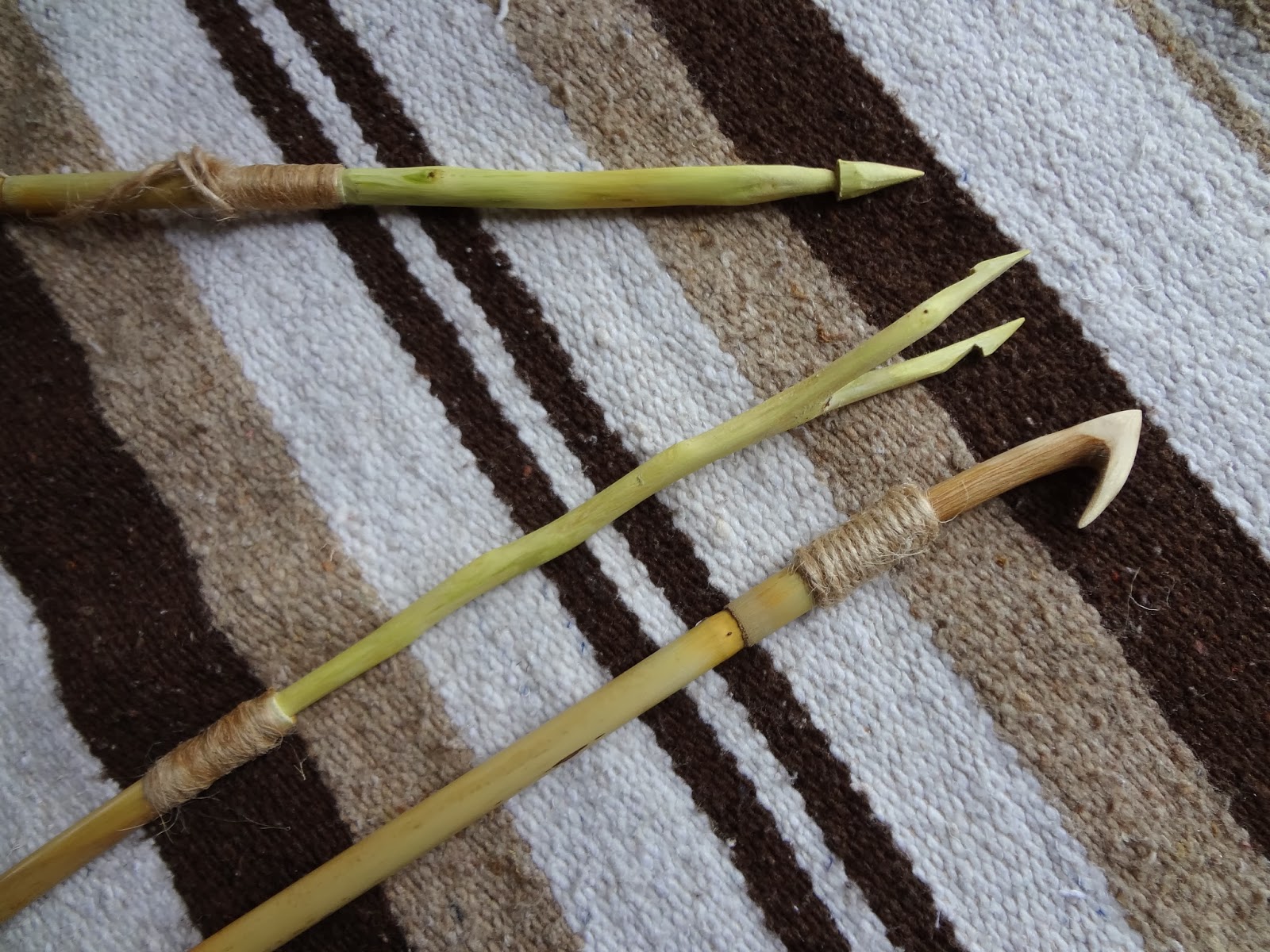
Spanish explorers were not prone to study the people’s technologies other than in passing.  Some of them noted that the Indians used arrows made of “carrizo” (reed) with hardwood fore-shafts.  Arrow points were sometimes hafted with asphaltum acquired from las playas (the beaches) along the Gulf of Mexico.  We can conjecture that a substantial trade in asphaltum worked its way inland from the coastline.  I have not read any accounts of bows being backed and it is unlikely, given the high humidity and rainfall, that prehistoric groups in the region used sinew or rawhide or any type of hide glue given the water-soluble nature of those products.  Most likely (based on my personal experience making dozens of bows and arrows using resources from the region) the Indians used cordage made from Agave (americana, lophantha, and scabra),and pita (Yucca treculeana) to secure the points and reinforce their carrizo arrow shafts.


The photos represent a conceptual representation of what the fishing arrows might have looked like.  The designs are, of course, universal and we know that North American fishing arrows more-or-less followed similar construction criteria: barbed points, plant-derived cordage, and in the case of reed arrow shafts, a hardwood foreshaft incorporating the point and barb.  The three arrows pictured have foreshafts made from mesquite (Prosopis glandulosa).  An arrow like the one pictured on the far right will plow through a large fish like an alligator gar if the bow is of adequate draw weight.  Agave cordage is used to reinforce the forend of the Phragmites arrow as well as to fashion the string that retrieves the fish.

Arrow nocks were sometimes reinforced with cordage.  Of course, no fletching was used on these fishing arrows and it is quite possible that within the riparian zones these same types of arrows may have been used to dispatch small game and even deer snared or trapped within the sinuous trails that wound through the forests.

Bow fishing or hunting using tools you made yourself is in fact no more challenging than if you were to employ store bought items.  But learning to make selfbows and arrows takes practice and patience as does learning to use them properly.  Even so, acquiring those skills provides a certain satisfaction and as many suggest places one ahead of those who venture into the wilds as if nothing more than appendages of the sporting goods store.


Monday, January 13, 2014

Don't Shoot the Messenger!...


Carrizo
“Common Reed”


Historical Background
Native Americans in the Southwestern United States and northern Mexico used carrizo (Phragmites australis) for everything from thatching the roofs of their jacales to making arrows, flutes, pipes, baskets, and even canoes.  The reed had medicinal uses and a sweet honey-like residue was harvested from aphids that lived on the slender stalks during summer.  There are records of carrizo used to make splints for broken bones as well as rattles for both curative ceremonies and social gatherings.  By the way, carrizo flutes were used both in celebrations and as part of the threatening gestures preceding attacks.


As a boy I spent holidays and summers living in a stone-walled cabin thatched with carrizo.  The thick roof kept us cool in the summer and warm in the winter.  This was in the state of Tamualipas, Mexico along the banks of the San Fernando River.  In those days farmers had yet to annihilate the brushlands.  But a few years later they arrived and leached the soil of its nutrients eventually turning much of the region into a desert.  The cabin sat on a hilltop and at the base of the hill near the river lived the ranch foreman and his wife.  They occupied two identically sized jacales (ha-khal-es).  One of the jacales served as cooking hut and the other as sleeping hut.  Both huts were made of mud and sticks formed into walls about eight inches thick.  The roof was thatched carrizo as was the porch connecting the two huts.  The foreman and his wife were indigenous people and they knew the ways of the land intimately.  Their ancestors had lived in the area for perhaps ten thousand years and their jacales were exactly like those built many centuries before.  Carrizo was such an integral part of the people’s lives that families cultivated it alongside rivers and swampy areas.  The ranch next to ours had a marshy lake that attracted hundreds of ducks and geese, and a hunter had built several duck blinds using clumps of carrizo tied together then piled one atop the other.  On another ranchito a man built a chicken coop with carrizo and on the road leading back 20 miles to the town a family had built a cortijo (cor-tee-ho) or farmhouse entirely with bundles of carrizo tied together into rigid walls.  The cortijo’s roof was thatched.  I’ve always wondered if sturdy and energy efficient houses couldn’t be built using Phragmites australis bundled in the same manner then sprayed with some sort of sealant and hardener.  A covering of chicken wire with stucco applied over it might serve as well as seen in straw baled dwellings.


Phragmites arrow shafts were used by many Native American tribes.

I enjoy making carrizo arrows.  Phragmites australis arrow shafts are sturdy enough to absorb the shock of being shot from a 40-50 pound bow.  A hardwood foreshaft is usually inserted into the front end of the reed extending two to six inches onto which a broadhead made of stone, bone or metal is hafted.  In the case of fishing arrows the foreshaft is notched with barbs and no feathers are added to the main reed shaft.  Carrizo measures between 3/8 and 5/8 inch in diameter and can grow to about twelve feet high.  A member of the grass family it’s actually more closely related to sugar cane than bamboo and yet one easily sees the family resemblance to the stouter bamboo species.

A Phragmites arrow nearing completion.

The Columbian Exchange
The arrival of Europeans on the North American continent in 1492 started what some historians call “The Columbian Exchange.”  In effect, European exploration and subsequent settlement initiated a transfer of biological species in both a western and eastern direction.  Potatoes, tobacco, cotton and corn went to Europe while wheat, barley, apples and almonds came to America.  The exchange included hundreds of plants and animals.  Europeans gave America rats and pigs while America gave Europe turkeys and llamas.  America received chicken pox, measles, leprosy and small pox; and Europe was paid back with syphilis and Chagas disease.  The list is long and complicated and as other parts of the world came to America the list grew longer and longer.  In fact, the exchange continues even today.

The War on Phragmites
But what of Phragmites?  You see, there is only one species of Phragmites and that is australis.  Some botanists have wanted to divide Phragmites australis into three species but so far their efforts have not been accepted by the botanical community.  This, however, is where things get complicated and perhaps a bit hypocritical.  You see Phragmites is found all over the world but in slightly different veneers or what biologists call “subspecies.”  These subspecies look essentially alike and only an expert can tell the difference.  But because of the Columbian Exchange various subspecies of Phragmites have arrived in the USA and a lot of people are upset over that fact.  A European subspecies of Phragmites is now “clogging” drainage areas and crowding other wetlands.  Remember that Phragmites has been here for thousands of years and, in fact, botanists call the US subspecies Phragmites australis americanus.  There is a southern subspecies called Phragmites australis berlandieri found in Mexico and the southwestern US.  Remember also these are all members of the same species with varying morphological features and ecological preferences.  Not to bore you here but here’s the rub: This newly “invasive” Phragmites subspecies is a result of human behavior.  Furthermore, Phragmites is not so much “invasive” as it is opportunistic.  In this sense the term invasive is not all that well thought out.  Phragmites, like many other species, simply accommodates itself to conditions that allow energy to flow more successfully through the environment.  Forgive me if this is getting a bit academic but it’s important to understand that ultimately all ecological systems focus on how effectively energy is transferred from one point to another.  Therefore, Phragmites (and other species) can be thought of as a super energy transfer mechanism within environments conducive to its growth.  But because Phragmites has been given such an excellent chance to succeed it has taken over in many cases.  Now this is important: Phragmites is actually a messenger telling us that our actions as humans are stressing the entire ecological system.  What’s upsetting is when we read reports from groups that should know better but instead issue calls for extermination as if reciting something by rote.  Here’s a case in point from The Nature Conservancy’s website.

“Over the last two centuries Indiana has lost 85% of its wetlands.  Many of the remaining wetlands have been dramatically altered, degraded by soil disturbance, increased sedimentation, nutrient loading and salinization from road salt.  These changes are bad for our native plants, but good for common reed.  Common reed, Phragmites australis, is an invasive perennial grass ranging in heights of 3-15 feet.  Its leaves are wide, smooth and flat with large, showy and feathery flowers that vary from a wheat color to grayish-purple when in fruit.  Dense stands are found in open wetland habitats, alongside rivers, shores of lakes and ponds and even in the polluted soils along roadsides and ditches.  Huge colonies form quickly, but not from seeds.  Instead, common reed relies on rhizomes, a horizontal stem that grows beneath the surface and sprouts new roots and shoots from underground, to invade our natural communities. A stand of common reed can extend its boundaries by as much as 50 feet within one season….Common reed competes with native wetland plants, and it plays to win.  Once introduced, it will overtake a marsh community quickly by crowding out native vegetation, changing marsh hydrology, altering wildlife habitat and increasing fire potential.  Its high biomass blocks light to other plants and occupies all the growing space below ground quickly turning a once diverse plant community into a phragmites monoculture.  Once established, it spreads like a thick blanket, smothering native vegetation and filling in shallow open water….”

The Nature Conservancy article paints a dim picture of Phragmites with little understanding of the greater ecological and ethical issues involved.  Perhaps unwittingly the writer admits in the first paragraph that human behavior is to blame for both the demise of local wetlands and the abundance of Phragmites.  (“Over the last two centuries Indiana has lost 85% of its wetlands.  Many of the remaining wetlands have been dramatically altered, degraded by soil disturbance, increased sedimentation, nutrient loading [via agriculture] and salinization from road salt.”)  The author errs by saying that Phragmites is not native.  As mentioned earlier Phragmites is native to North America in the form of Phragmites australis americanus and Phragmites australis berlandieri but (due to the Columbian Exchange) the European subspecies has arrived in the US.

The Nature Conservancy suggests that Phragmites be dealt with by using a poisonous herbicide called “Rodeo” that many consider harmful to the environment as well as human health.  One begins to wonder if all of this is actually less about maintaining a stable ecosystem and, in fact, more about economic gains.  An article in the New York Times “Business Day” segment published on September 13, 2013 entitled, “Misgivings about how a weed killer affects the soil,” notes the harmful outcomes of this class of herbicide on soil constituents and the overall ecology.  But what is most revealing in this article is that farmers insist on using these deleterious herbicides because they make their business more profitable.  In other words, it’s less about the environment and more about profit.  “Anything you put on the land affects the chemistry and biology of the land, and that’s a powerful pesticide,” noted a farmer named, Von Arb in the New York Times article.  But another farmer countered that “it’s just too profitable to give up [the use of powerful herbicides.]”  Even so, the literature is filled with reports of how herbicides affect the environment in negative ways.  Herbicides devastate earthworms that are so vital to a healthy soil matrix.  They are likewise harmful to sensitive individuals that might breathe the fumes or in some way come in contact with the poison.  Herbicides also harm our pollinators that are already diminishing in most places; and they kill many amphibians in wetland areas as well.

It’s important to know that many groups, particularly with business interests, are promoting mass eradication of Phragmites for everything from increased urban development to improved drainage systems.  But perhaps The Nature Conservancy should have focused on those human caused stimuli that are creating unstable ecosystems instead of simply urging the destruction of a plant that is doing nothing more than sending us a message about how we’re harming the planet.  Besides, killing off Phragmites with herbicides will only create other problems.  It has solved nothing in the long run.  Urban sprawl and increased agricultural pollution will do more to eradicate wetlands (as it has done already) than Phragmites australis or similar opportunistic plants.  Hopefully, The Nature Conservancy will act more responsibly and evaluate things more eclectically in the future.  But I wonder if any of you have noted the irony in all of this.  The word invasive has become quite popular in the world of biology.  Any plant or animal is now considered invasive if it crowds out economic interests or if it is believed to threaten what biologists consider historical plant or animal populations.  So let me see now: Once there was a biological subspecies living in America that was crowded out by another subspecies from Europe.  The European subspecies is therefore “invasive” and according to the logic applied by groups like The Nature Conservancy and others it should be eradicated.  Hmmm, I don’t think the folks at The Nature Conservancy are much into deep analysis.

Here’s the article from The Nature Conservancy: