Tuesday, February 11, 2014

What Good is Your Knife if You're Dying of Thirst?

Photo from Common Dreams

The above photo shows the extent to which hydraulic fracturing, otherwise known as “fracking,” is poisoning America’s underground water supplies.  Areas that cannot afford to lose their subsurface water are also the places where poisons and carcinogens are being pumped hourly into the ground in order to extract natural gas.  I’ve placed a link below to a MUST READ article about the extent to which your groundwater is being lost to the oil and gas mafia.  So tell me: What good are your knives if you’re dying of thirst?


Monday, February 10, 2014

EDU: Everyday Used Pocketknives

I get a lot of emails asking what pocketknives I carry.  Allow me to differentiate between Everyday Carry (EDC) and Everyday Used (EDU) pocketknives.  An EDC pocketknife might indeed be carried but is seldom used.  On the other hand, an EDU pocketknife sees action all day long.  It’s a knife usually so worn and frequently sharpened its lifetime is limited to only a few years.  From cutting bailing twine to garden stakes or opening crates and boxes or whittling pieces of wood to clipping small branches to severing rope and wire and perhaps even trimming fingernails; the EDU pocketknife is undoubtedly the most frequently used tool on any ranch.  Of course, one’s EDU pocketknife is a purely subjective decision and I’ve seen all makes and models overtime.  I’ve examined EDU folders with chipped scales and missing blades and some so crudely sharpened it’s amazing they work.  I’ve seen all sorts of brands.  

Most ranch-hands carry folders they purchased at the pulga or flea market.  These are economic decisions based on salary and other pressing needs.  Besides, they know the knife might see torturous use so they’re not about to spend a week’s wages on something that will be quickly marred, scratched or even broken.  They probably consider anything over about fifteen bucks both frivolous and imprudent.

I’ve seen knife forum posts where someone asks, “Show me what EDC folder you carried today.”  Invariably the knives displayed are shiny and clean and most of them look practically new.  These are knives carried for no other reason than the joy of owning and toting a folder.  Nothing wrong with that but those knives might see nothing more during the day than opening a letter or slicing a piece of cheese at the deli.  But EDU pocketknives (especially those used on ranches, the outback and way out yonder) are something else entirely.  Just the other day a fellow was out here helping me with some work and he pulled out a stainless lock-blade with skeletonized scales and clip-point that was deeply scored.  The steel was 440A and the scales were plastic.  The bevel looked like a cross between convex, concave and even Scandi.  The knife didn’t come that way but the young vaquero carrying it didn’t seem all that concerned with which way the bevel went as long as it cut whatever needed cutting.  He took a segment of electrical wire and then pulled his folder from its leather sheath and went to work gnawing the blade through the copper.  I didn’t say anything (after all it was his knife) but afterwards he turned to me and asked for a file.  There was a crosscut steel file on one of the workbenches and I pointed to it.  He grabbed it then gave his knife a quick once over.  I could see burrs forming along the edge.  So I asked him for the knife and then gave it a few swipes on a leather strop.  “Just like the barber shop,” he said.  Then I tested the edge and sure enough it was sharp so we went back to work.

Mind you some ranch-hands carry a couple of knives: A folder and a fixed blade.  But that’s not very common and as mentioned above they are invariably inexpensive blades.  I’ve gotten a few emails about “buying American” and that sort of thing.  Unfortunately, American-Made has become a niche item of sorts.  Just like the $140 American-made Levi jeans compared to the $30 foreign imports.  I’m not much of a Levi’s fan but I hope that makes the point.  The same people who want to sell you something for an “American Price” will turn around and buy their goods at a foreign-made price.  I’ve seen that too many times to be swayed otherwise.  But I saw a documentary recently about inflation and costs and a system that prints money based on thin air with ever increasing debt and….well, I’d best get back to talking about knives.


Pictured above are my three EDU pocket knives.  They’re not all that pretty but they work and that’s what counts.  The yellow scaled folder is made by Case and the dark scaled knife is a Böker, both carbon steel.  I assume you all recognize the Swiss Army Knife.  And yes, I carry three EDU knives and they all get used every day, all day and into the night.  I want them razor sharp and so I put them to my little diamond stone frequently.  What good is a knife, after all, if it’s not sharp?


I’ve got other knives and if you’ve perused this commentary you know I think fondly about knives.  I even make my own knives for woodcarving and chopping.  But my most used knives are folders.  From making arrows to bows to fishing hooks and barbs and all the things mentioned at the top of this piece my EDU jacks are always within grasp.  Somewhere down the line they’ll wear out just like I’ll wear out (and you will too) and the knives pictured will get retired and put in a drawer somewhere.  Well, you can extrapolate the rest, I’m sure.

Friday, January 24, 2014

The Ancient Fishing People of the Río Grande Delta Region of South Texas and Northeastern Mexico….

When most of us think of the bow and arrow we imagine prehistoric cultures hunting large animals like deer, bear and buffalo.  But in some regions they were used more often for fishing.  One place in particular that saw extensive use of the bow and arrow for fishing was the delta region of Deep South Texas and extreme northeastern Mexico.  It’s not hyperbole for people to refer to the river traversing that expanse as the “Rio Grande” on the Texas side and “El Río Bravo” on the Mexican side.  The word “grande” means “big” and the word “bravo” means “fierce.”  In ancient times it was indeed a large and ill-tempered river.  Massive floods increased the river’s girth by many miles and likewise turned much of it into a killer of both men and beasts.  No one knows what tragedies occurred along the Río Grande/Bravo but we can assume its name is well deserved.  Of course, “progress” turned this once raging river into a bloated sloth with dozens of dams built along its route from New Mexico to the tip of Texas.  Today the Rio Grande (Río Bravo) is but a vestige of its former times.

The earliest Spanish explorers to the region made frequent note of coming across Indians who were fishing the tributaries, resacas, and the great river itself with bows and arrows.  Others mention that family groups dwelled on islands within the Rio Grande and traveled from one small village to another using canoes made from carrizo (Phragmites australis) and perhaps dugouts of Sabal palm or Montezuma Bald Cypress.  Some of these islands still exist in Starr County, Texas near the town of Roma.  In my book, Adios to the Brushlands, (Texas A&M University Press, 1997) I write about a trip to those islands.  They are small compared to the larger islands of ancient times but one still captures the sense of tranquility and remoteness the people of those times must have felt.  They were hidden and protected and at the same time surrounded by an abundant food source.  The great river on all sides of them teamed with sustenance ranging from fish to clams to small river shrimp.  In addition the people planted gardens and made forays into the riparian forests along the river’s banks to hunt deer and small game.  Perhaps the only drawback was swarming mosquitoes so the people covered themselves with mud to thwart the insect’s seasonal attacks.  Of course, there were also tropical diseases to contend with from malaria to yellow fever.  Life had its challenges but it cannot be said that today’s lifestyles are less stressful than those of the people who lived on the islands and surrounding areas near the Rio Grande.


Spanish explorers were not prone to study the people’s technologies other than in passing.  Some of them noted that the Indians used arrows made of “carrizo” (reed) with hardwood fore-shafts.  Arrow points were sometimes hafted with asphaltum acquired from las playas (the beaches) along the Gulf of Mexico.  We can conjecture that a substantial trade in asphaltum worked its way inland from the coastline.  I have not read any accounts of bows being backed and it is unlikely, given the high humidity and rainfall, that prehistoric groups in the region used sinew or rawhide or any type of hide glue given the water-soluble nature of those products.  Most likely (based on my personal experience making dozens of bows and arrows using resources from the region) the Indians used cordage made from Agave (americana, lophantha, and scabra),and pita (Yucca treculeana) to secure the points and reinforce their carrizo arrow shafts.


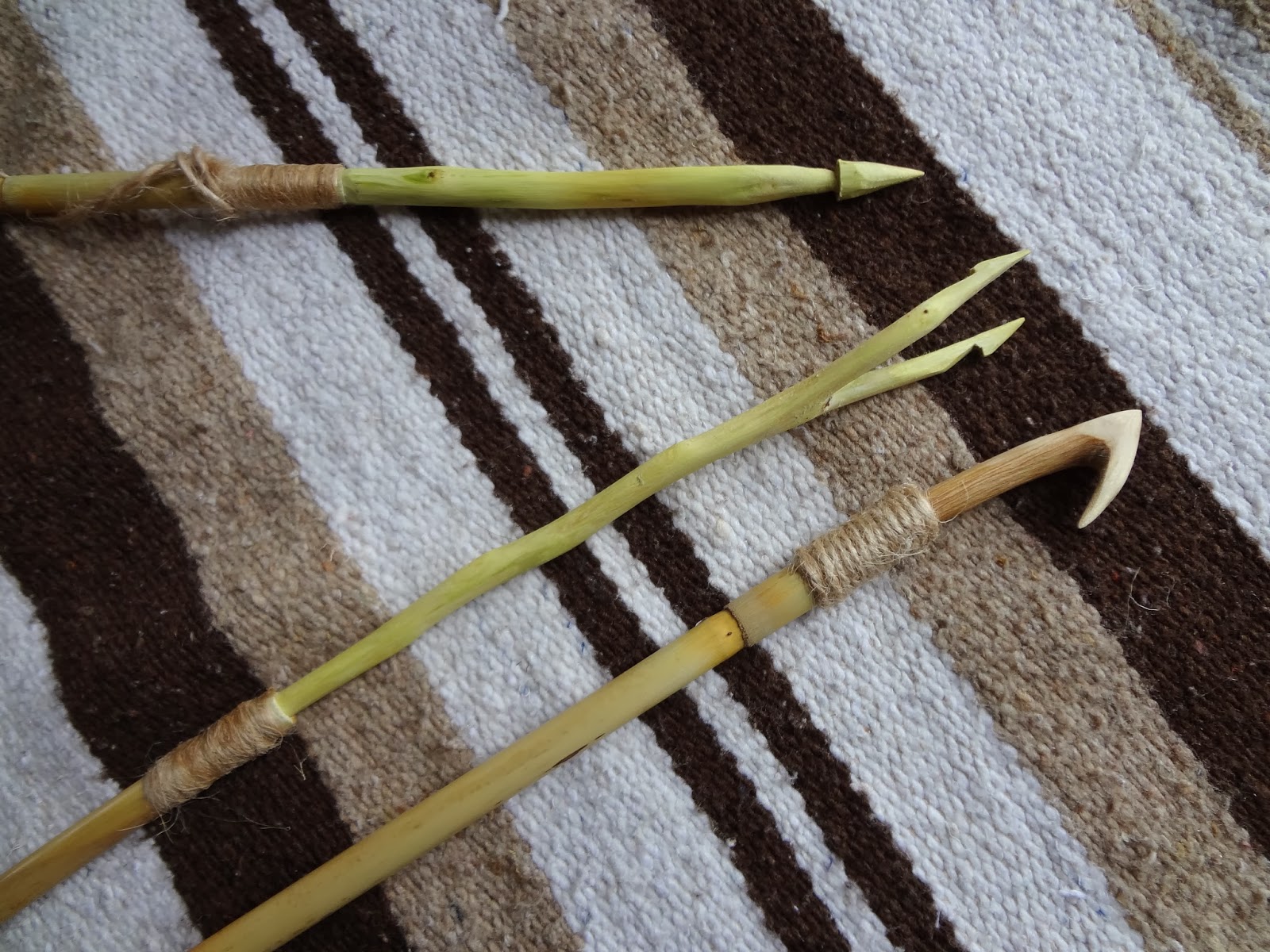
The photos represent a conceptual representation of what the fishing arrows might have looked like.  The designs are, of course, universal and we know that North American fishing arrows more-or-less followed similar construction criteria: barbed points, plant-derived cordage, and in the case of reed arrow shafts, a hardwood foreshaft incorporating the point and barb.  The three arrows pictured have foreshafts made from mesquite (Prosopis glandulosa).  An arrow like the one pictured on the far right will plow through a large fish like an alligator gar if the bow is of adequate draw weight.  Agave cordage is used to reinforce the forend of the Phragmites arrow as well as to fashion the string that retrieves the fish.

Arrow nocks were sometimes reinforced with cordage.  Of course, no fletching was used on these fishing arrows and it is quite possible that within the riparian zones these same types of arrows may have been used to dispatch small game and even deer snared or trapped within the sinuous trails that wound through the forests.

Bow fishing or hunting using tools you made yourself is in fact no more challenging than if you were to employ store bought items.  But learning to make selfbows and arrows takes practice and patience as does learning to use them properly.  Even so, acquiring those skills provides a certain satisfaction and as many suggest places one ahead of those who venture into the wilds as if nothing more than appendages of the sporting goods store.


Monday, January 13, 2014

Don't Shoot the Messenger!...


Carrizo
“Common Reed”


Historical Background
Native Americans in the Southwestern United States and northern Mexico used carrizo (Phragmites australis) for everything from thatching the roofs of their jacales to making arrows, flutes, pipes, baskets, and even canoes.  The reed had medicinal uses and a sweet honey-like residue was harvested from aphids that lived on the slender stalks during summer.  There are records of carrizo used to make splints for broken bones as well as rattles for both curative ceremonies and social gatherings.  By the way, carrizo flutes were used both in celebrations and as part of the threatening gestures preceding attacks.


As a boy I spent holidays and summers living in a stone-walled cabin thatched with carrizo.  The thick roof kept us cool in the summer and warm in the winter.  This was in the state of Tamualipas, Mexico along the banks of the San Fernando RiverIn those days farmers had yet to annihilate the brushlands.  But a few years later they arrived and leached the soil of its nutrients eventually turning much of the region into a desert.  The cabin sat on a hilltop and at the base of the hill near the river lived the ranch foreman and his wife.  They occupied two identically sized jacales (ha-khal-es).  One of the jacales served as cooking hut and the other as sleeping hut.  Both huts were made of mud and sticks formed into walls about eight inches thick.  The roof was thatched carrizo as was the porch connecting the two huts.  The foreman and his wife were indigenous people and they knew the ways of the land intimately.  Their ancestors had lived in the area for perhaps ten thousand years and their jacales were exactly like those built many centuries before.  Carrizo was such an integral part of the people’s lives that families cultivated it alongside rivers and swampy areas.  The ranch next to ours had a marshy lake that attracted hundreds of ducks and geese, and a hunter had built several duck blinds using clumps of carrizo tied together then piled one atop the other.  On another ranchito a man built a chicken coop with carrizo and on the road leading back 20 miles to the town a family had built a cortijo (cor-tee-ho) or farmhouse entirely with bundles of carrizo tied together into rigid walls.  The cortijo’s roof was thatched.  I’ve always wondered if sturdy and energy efficient houses couldn’t be built using Phragmites australis bundled in the same manner then sprayed with some sort of sealant and hardener.  A covering of chicken wire with stucco applied over it might serve as well as seen in straw baled dwellings.


Phragmites arrow shafts were used by many Native American tribes.

I enjoy making carrizo arrows.  Phragmites australis arrow shafts are sturdy enough to absorb the shock of being shot from a 40-50 pound bow.  A hardwood foreshaft is usually inserted into the front end of the reed extending two to six inches onto which a broadhead made of stone, bone or metal is hafted.  In the case of fishing arrows the foreshaft is notched with barbs and no feathers are added to the main reed shaft.  Carrizo measures between 3/8 and 5/8 inch in diameter and can grow to about twelve feet high.  A member of the grass family it’s actually more closely related to sugar cane than bamboo and yet one easily sees the family resemblance to the stouter bamboo species.

A Phragmites arrow nearing completion.

The Columbian Exchange
The arrival of Europeans on the North American continent in 1492 started what some historians call “The Columbian Exchange.”  In effect, European exploration and subsequent settlement initiated a transfer of biological species in both a western and eastern direction.  Potatoes, tobacco, cotton and corn went to Europe while wheat, barley, apples and almonds came to America.  The exchange included hundreds of plants and animals.  Europeans gave America rats and pigs while America gave Europe turkeys and llamas.  America received chicken pox, measles, leprosy and small pox; and Europe was paid back with syphilis and Chagas disease.  The list is long and complicated and as other parts of the world came to America the list grew longer and longer.  In fact, the exchange continues even today.

The War on Phragmites
But what of Phragmites?  You see, there is only one species of Phragmites and that is australis.  Some botanists have wanted to divide Phragmites australis into three species but so far their efforts have not been accepted by the botanical community.  This, however, is where things get complicated and perhaps a bit hypocritical.  You see Phragmites is found all over the world but in slightly different veneers or what biologists call “subspecies.”  These subspecies look essentially alike and only an expert can tell the difference.  But because of the Columbian Exchange various subspecies of Phragmites have arrived in the USA and a lot of people are upset over that fact.  A European subspecies of Phragmites is now “clogging” drainage areas and crowding other wetlands.  Remember that Phragmites has been here for thousands of years and, in fact, botanists call the US subspecies Phragmites australis americanus.  There is a southern subspecies called Phragmites australis berlandieri found in Mexico and the southwestern US.  Remember also these are all members of the same species with varying morphological features and ecological preferences.  Not to bore you here but here’s the rub: This newly “invasive” Phragmites subspecies is a result of human behavior.  Furthermore, Phragmites is not so much “invasive” as it is opportunistic.  In this sense the term invasive is not all that well thought out.  Phragmites, like many other species, simply accommodates itself to conditions that allow energy to flow more successfully through the environment.  Forgive me if this is getting a bit academic but it’s important to understand that ultimately all ecological systems focus on how effectively energy is transferred from one point to another.  Therefore, Phragmites (and other species) can be thought of as a super energy transfer mechanism within environments conducive to its growth.  But because Phragmites has been given such an excellent chance to succeed it has taken over in many cases.  Now this is important: Phragmites is actually a messenger telling us that our actions as humans are stressing the entire ecological system.  What’s upsetting is when we read reports from groups that should know better but instead issue calls for extermination as if reciting something by rote.  Here’s a case in point from The Nature Conservancy’s website.

Over the last two centuries Indiana has lost 85% of its wetlands.  Many of the remaining wetlands have been dramatically altered, degraded by soil disturbance, increased sedimentation, nutrient loading and salinization from road salt.  These changes are bad for our native plants, but good for common reed.  Common reed, Phragmites australis, is an invasive perennial grass ranging in heights of 3-15 feet.  Its leaves are wide, smooth and flat with large, showy and feathery flowers that vary from a wheat color to grayish-purple when in fruit.  Dense stands are found in open wetland habitats, alongside rivers, shores of lakes and ponds and even in the polluted soils along roadsides and ditches.  Huge colonies form quickly, but not from seeds.  Instead, common reed relies on rhizomes, a horizontal stem that grows beneath the surface and sprouts new roots and shoots from underground, to invade our natural communities. A stand of common reed can extend its boundaries by as much as 50 feet within one season….Common reed competes with native wetland plants, and it plays to win.  Once introduced, it will overtake a marsh community quickly by crowding out native vegetation, changing marsh hydrology, altering wildlife habitat and increasing fire potential.  Its high biomass blocks light to other plants and occupies all the growing space below ground quickly turning a once diverse plant community into a phragmites monoculture.  Once established, it spreads like a thick blanket, smothering native vegetation and filling in shallow open water….”

The Nature Conservancy article paints a dim picture of Phragmites with little understanding of the greater ecological and ethical issues involved.  Perhaps unwittingly the writer admits in the first paragraph that human behavior is to blame for both the demise of local wetlands and the abundance of Phragmites.  (“Over the last two centuries Indiana has lost 85% of its wetlandsMany of the remaining wetlands have been dramatically altered, degraded by soil disturbance, increased sedimentation, nutrient loading [via agriculture] and salinization from road salt.”)  The author errs by saying that Phragmites is not native.  As mentioned earlier Phragmites is native to North America in the form of Phragmites australis americanus and Phragmites australis berlandieri but (due to the Columbian Exchange) the European subspecies has arrived in the US.

The Nature Conservancy suggests that Phragmites be dealt with by using a poisonous herbicide called “Rodeo” that many consider harmful to the environment as well as human health.  One begins to wonder if all of this is actually less about maintaining a stable ecosystem and, in fact, more about economic gains.  An article in the New York Times “Business Day” segment published on September 13, 2013 entitled, “Misgivings about how a weed killer affects the soil,” notes the harmful outcomes of this class of herbicide on soil constituents and the overall ecology.  But what is most revealing in this article is that farmers insist on using these deleterious herbicides because they make their business more profitable.  In other words, it’s less about the environment and more about profit.  “Anything you put on the land affects the chemistry and biology of the land, and that’s a powerful pesticide,” noted a farmer named, Von Arb in the New York Times article.  But another farmer countered that “it’s just too profitable to give up [the use of powerful herbicides.]”  Even so, the literature is filled with reports of how herbicides affect the environment in negative ways.  Herbicides devastate earthworms that are so vital to a healthy soil matrix.  They are likewise harmful to sensitive individuals that might breathe the fumes or in some way come in contact with the poison.  Herbicides also harm our pollinators that are already diminishing in most places; and they kill many amphibians in wetland areas as well.

It’s important to know that many groups, particularly with business interests, are promoting mass eradication of Phragmites for everything from increased urban development to improved drainage systems.  But perhaps The Nature Conservancy should have focused on those human caused stimuli that are creating unstable ecosystems instead of simply urging the destruction of a plant that is doing nothing more than sending us a message about how we’re harming the planet.  Besides, killing off Phragmites with herbicides will only create other problems.  It has solved nothing in the long run.  Urban sprawl and increased agricultural pollution will do more to eradicate wetlands (as it has done already) than Phragmites australis or similar opportunistic plants.  Hopefully, The Nature Conservancy will act more responsibly and evaluate things more eclectically in the future.  But I wonder if any of you have noted the irony in all of this.  The word invasive has become quite popular in the world of biology.  Any plant or animal is now considered invasive if it crowds out economic interests or if it is believed to threaten what biologists consider historical plant or animal populations.  So let me see now: Once there was a biological subspecies living in America that was crowded out by another subspecies from Europe.  The European subspecies is therefore “invasive” and according to the logic applied by groups like The Nature Conservancy and others it should be eradicated.  Hmmm, I don’t think the folks at The Nature Conservancy are much into deep analysis.

Here’s the article from The Nature Conservancy:

Saturday, December 21, 2013

How to Make Suet for Your Backyard Birds....


One of the best presents you can give your birds is a batch of homemade suet.  It’s easy to make and your birds will love it.  We make enough suet to last about three weeks and as I write these notes four great kiskadees, three green jays, two golden fronted woodpeckers and two titmice are flying back and forth between our suet stations.  We place the suet about seven feet high in two mesquite trees and the only thing to watch out for are ants that find suet as scrumptious as the birds.  Sprinkle a small amount of insecticide at the base of the trees to keep them free of marauding ants.


The process we use was concocted using several recipes available online and in a number of books.  Our recipe is tweaked to meet our needs. It calls for the following ingredients:
1 Cup Chunky Peanut Butter
2-3 Cups of Mixed Bird Seed (we use three cups)
3 Cups Yellow Corn Meal
2 Cups Bleached or Unbleached Flour
1 Cup Lard or Shortening


Place the lard and the peanut butter in a large pot.  Put the pot on the stove at medium heat.  Remove the pot from the heat when the lard and peanut butter are melted.


Now add the corn meal, flour and bird seed into the pot and stir until well blended.  Place the mixture into a container sized appropriately to fit your suet cage.  Be sure and spray the containers with non-stick cooking spray before you fill them with the suet mixture!


We use plastic containers saved from guacamole purchased at the grocery store or from store bought suet.  In other words, be on the lookout for suitable containers.


Now place your completed suet containers in the freezer or refrigerator to set.  This will take about an hour in the freezer.


Fit the frozen suet into a suet cage and then sit back and enjoy watching your birds gobble it up.


Okay, fellow birders.  Can you identify the birds pictured above? 

Friday, December 20, 2013

Chile Del Monte for Augmenting Bird Habitat....


This is a busy time of year but I still find a few minutes each day to roam the woods surrounding the cabin.  I planted Phragmites australis (carrizo) rhizomes around the gray water outlet to help keep the pond area clean as well as provide a steady supply of arrow shafts à la Lipan Apache.  We’ll be putting in a second pond after the first of the year expressly for wildlife.  The birding has been phenomenal this fall and we spent a few minutes earlier today making a fresh batch of suet for the great kiskadees, green jays and golden fronted woodpeckers as well as a number of sparrow species and titmice that ravage our suet stations daily.

We’re lucky because chile del monte (chile pequin; chile petin), Capsicum annuum, grows wild around the house particularly in the granjeno/brasil/mesquite motts that make up this section of the South Texas desert also known as the Sand Sheet.  We live on the very edge of the desert so there’s a mix of classic Texas Brushland flora to the south of us and Sand Sheet flora to the north.  This makes for an interesting array of woody plants and herbaceous shrubs as well as a consortium of cacti within a few steps of my home.


I picked a few chiles the other day behind the house.  Mind you, chile del monte is hot but the mockingbirds don’t seem to mind.  Most plants get raided by the birds long before I spot them.  Look for the bright red dots in shaded areas within the motts.  Now if you live in town and the climate is sufficiently warm for chile del monte then you can have your own food source within reach.  If you’re a birder then you might consider adding chile del monte to your garden.  Unfortunately, chile del monte is susceptible to cold temperatures so that rules out planting in temperate climates.  Growing chile del monte is difficult unless you’ve got mockingbirds in your area.  But here’s how to grow this chile around your yard in abundance.  First you need some sort of fence or similar object where mockingbirds can perch.  Weed the area directly under your fence on both sides if possible and add a generous amount of potting soil.  Chile del monte is drought tolerant but requires shade and moderately moist soil.  Second you need a preliminary source of chile del monte.  Some grocery stores sell the chile so buy a large bag full and then place most of it in your bird feeders.  The mockingbirds will find the chile soon enough and gobble it up.  Then they will take a respite on your cedar fence or comparable platform nearby to digest their meal.  In order for chile del monte to sprout it must go through the gut of a mockingbird or at least that’s the easiest way to propagate the plant.  In no time you’ll have a line of chile plants growing along your fence or the back end of the dog house or behind the monkey bars or anyplace the birds can perch.  Now and then if you have a hankering for chile del monte you can go out and pick a couple or three and pop them in your mouth.  By the way, ice tea works well for quenching the fire.

Friday, December 6, 2013

An Inexpensive Arrow Quiver....

I’ve seen arrow quivers made from old cowboy boots, woven river cane (Phragmites and Arundo) and willow branches, brain-tanned deer hide, cowhide, PVC pipe, and canvas.  Some arrow quivers are short affairs about 15-inches long while others are up to 30 inches.  I’ve experimented with varying lengths and while the shorter quivers enable one to extract an arrow with less fuss, the longer quivers offer more protection in thick or briary habitats.  I live in what some people call “The Thorn Forest” so I prefer longer quivers.  Regardless, the arrow quiver is the cumbersome part of the bow and arrow duo.  Some bow hunters use a quiver that attaches to the bow and those are quite handy.  Years ago when I hunted with fiberglass recurves I always used a bow-limb attached quiver but since going au naturel (“Sin artificio ni mezcla o elaboración.”) I’ve opted for traditional over-the-shoulder or across-the-back quivers.  Mind you, when I hunt (I’m more of a target shooter these days) I lean several arrows against a branch or nearby bush so I can easily reach them if needed.


A week ago I decided to make a new quiver.  I used a remnant piece of upholstery leather placed inside out, an inexpensive rawhide dog chew, some 1/8 inch wide rawhide thread I’d made from deer skin and a shaft made from granjeno (gran-hen-no) known scientifically as (Celtis pallida).  I dyed the leather and rawhide with a concoction made from dried cranberries, alcohol, and the roots and bark of colima (Zanthoxylum fagara).  By the way, I’m still experimenting with the formula.

Upholstery and dog chew rawhide

In case you’re interested the arrows in the quiver were made from Phragmites australis berlandieri.  Phragmites was used by a number of Indian groups to make their arrows.  Spanish explorers noted on several occasions that the Indians in what is  now known as northeastern Tamaulipas, Mexico and South and Southwest Texas made their arrows with phragmites.  NOTE: I will be posting an article about the current controversies surrounding phragmites and why both government agencies and environmental groups are “shooting the messenger” instead of dealing with the real underlying ecological problems.  Please keep an eye out for that article.

Close up of the granjeno shaft.

I fletched the arrows with commercial turkey feathers.  I painted the white turkey feathers with a compound I’ve been experimenting with that more-or-less make them look like feathers from the genus Buteo.  The experiment has been only partially successful and thus disappointing because the dye either fades quickly or simply rubs off in my hands.  You’ll note that I used plastic nocks on my arrows.  Those nocks are inexpensive and far less susceptible to damage and they work for me.  I’ve also made nocks directly into the phragmites and by inserting small pieces of wood into the cane as was done by some Indian tribes.

Rawhide broadpoint shield at the base of the quiver.


The quiver measures 28 inches in length.  The dog chew rawhide was allowed to soak in water for an hour then carefully unraveled.  I wrapped the dog chew rawhide around the base of the quiver; it’s the cranberry red portion in the photographs.  When dry the rawhide becomes stiff and hard and thus serves to protect the bowyer from being punctured by razor-sharp broadheads.  The granjeno shaft keeps the quiver from collapsing when empty.  The rawhide thread was placed on dry and then wetted with my homemade dye.  Like the rawhide shield at the base of the quiver, the rawhide thread became quite stiff when dry.  The quiver weighs but a few ounces.  I prefer my hunting quivers to hold no more than about six or seven arrows.  In the places I hunt there is no need to carry more arrows.  Folks, if you miss with the first shot your chances of getting a second shot range from zero to practically nonexistent so in truth the only reason to carry more than a couple of arrows is in case you need to shoot several “finishers” into your quarry.  The biggest mistake I’ve seen novice bow hunters make is stationing themselves too far from the spot where they expect to see game when they do not have the skills to consistently make that shot.  So learn to shoot first and then learn to get close.  Otherwise you’re being imprudent and callous.  Besides, all true hunters view killing as the tragic side of acquiring food.  “Sport hunters” be damned and that sort of thing for they are neither hunters nor true woodsmen.