Wednesday, October 9, 2013

The Two Sides of Tracking....


It’s nice to get into the woods with someone who’s an expert tracker.  Never talks loudly, keeps their nose to the wind and their eyes along the skyline and then takes note of not only the tracks but the plants, birds and insects as well.  By the way, the really great trackers can identify every plant and bird because tracking is just a part of their overall woods knowledge.  Years ago I knew a fellow who was a great tracker.  He was about 50 years older than I was and I’d drop by his place in the woods and he’d make me a cup of coffee.  We’d talk about the Brushlands and about hunting and sometimes he’d ask me if I wanted to walk with him because he was looking for one thing or another.  It was an education just watching that man move through the woods.  We never said a word while woods roaming or tracking; and we would just keep going sometimes zigzagging left or right but always on the trail.  He’s been gone awhile but I think of him often.

Trackers come in two varieties: Those who read sign and those who feel sign.  The first type traces the route an animal took by dutifully taking note of every nuance like the tracks themselves or bent twigs, droppings, bits of fur and residual odors.  People who “feel” sign are something quite different.  They experience the animal as it wandered through the woods or fled the scene.  In a sense they become the animal, or so it seems, as they move into the forests and hills oftentimes going directly to where the beast is lying or hiding.  Both types are successful but the first is more mechanical while the second often appears clairvoyant.  Of course, those who track by feel will also check for physical sign just to make sure their senses aren’t fooling them.

So what is it that allows some people to track by feel?  Simply put, they have a vast body of experience in the woods.  Like that old man I used to know.  It’s not necessarily that they are born with the gift although they tend to be infatuated with the outdoors from childhood.  But a life in the woods taking note of all things turns them into what can only be described as part deer or coyote or bear or cougar.  In other words, it becomes part of who they are.

When I was a kid a buddy of mine and I made a great effort to learn how to track.  It was, however, something that for us was as much a part of our survival as it would be for a city dweller to learn to negotiate neighborhoods or alleyways.  We spent most of our time in the woods and as such we were forced to understand our surroundings or suffer the consequences.  We were in grade school and were often left alone in very remote places.  The itinerary was broad and somewhat vague but essentially one learned to observe every sound and memorize any new scent and study each and every track be it from a mammal or reptile or even an insect.  We learned to never speak loudly; in fact, we often went for days without ever talking above a whisper.  It helped that we were both enamored with nature and couldn’t think of ever living anywhere else.  Perhaps you’ve heard the saying that commonalities foster friendship or at least encourage assembly.  People who don’t drink or smoke won’t be found in a bar, for example.  And people who are committed woods types don’t fare well in cities.

But tracking in its simplest forms is not an art but instead a technical achievement.  There are scores of books on tracking and most people, if they spend enough time in nature, can become rudimentary trackers.  I see this every hunting season when somebody shoots a deer and it runs off and then someone follows the blood trail and finds the downed animal.  But that is not tracking nor is tracking necessarily following a line of footprints.  No, tracking in its finest manner is the art of learning to interpret sign and to see ahead—not so much into the future but into the past.  A great tracker can see the animal or person as they walked through the area an hour before or a day before.  Superior trackers can “cut sign” that’s a week old.

There aren’t many good trackers anymore.  And why should there be?  It’s a skill that’s really not needed.  Even the US Border Patrol that once upon a time was known for having some fairly good trackers is no longer focused on producing great sign cutters.  After all, we live in a technological world with electronic sensors and helicopters and drones and even satellite imagery.  The USBP drives around or sits in their vehicles waiting for sensors to go off.  Or if at night they depend on night-vision equipment and radio communications.  There’s absolutely nothing wrong with that other than the knowledge of tracking has essentially vanished from that organization.  There are a few holdouts but they’re rare.  Several months ago a fellow from the Hebbronville, Texas BP station called me to talk about some tracking he’d accomplished.  I was pleased to hear he took tracking seriously.  But I recall not too long ago arriving at a brushy tract and a BP fellow approached my truck and said, “We’ve got a helicopter coming because there are about fifteen illegals hiding over there in that brush.”  I nodded and said okay since I was the owner of that land.  Within a few minutes a helicopter arrived and started making all sorts of noise.  Six or seven BP also showed up along with several US Army types replete with M16s, camouflage and fancy sunglasses.  I was collecting some pieces of wood to make knife handles so I kept to myself and let the fellows and chopper do their thing.  But after about twenty minutes of noise and guys walking back and forth behind me everything grew quiet.  I looked around but everyone had left.  After another few minutes I decided to walk into the brush where the BP said the illegals were hiding.  In all there had been about 10-12 pairs of boots on the ground but no one had come by to tell me whether or not they’d found anyone.  So anyway I started walking quietly (what a relief to have that noisy chopper gone) and entered a narrow trail leading into thicker brush.  I’d gone about 100 yards when I turned to my left and saw eight fellows sound asleep in a shallow gully.  Folks, I was dumbfounded.  I could see where the BP and the Army people had walked that very trail only minutes before.  All they had to do was look to their left and they would have seen those guys fast asleep—even as the chopper burned fuel overhead!  “Hey, wake up,” I said.  But those boys were off in dreamland.  So I fired three 20 gauge rounds into the air and that woke them up.  “What are you guys doing here?” I said.  But they didn’t say anything and just got up and we all walked to this little road another hundred yards away.  Just then several BP fellows approached from a grassy field along with a couple of US Army guys.  One of the BP fellows asked, “Who found them?”  I was not thinking kind thoughts towards the BP at that moment but nonetheless I said, “I did.”  I could see the look on that BP guy’s face as he realized the old woods rat he’d seen earlier knew a few things about the thorn country.

I once helped find a man who’d been lost for about a week in some thick woods.  Scores of law enforcement people and others on horseback had obliterated all the sign and so it became a matter of sensing the man as he walked perhaps lost and scared.  I entered the thickets just after daybreak and about forty minutes later I felt something nearby.  All around me were horse tracks and horse dung and dozens of tread-soled boot prints.  Sadly, the man had faded away probably that night after having had a stroke or heart attack.  Not more than 100 feet from where he lay were horse tracks.  When his wife showed up to identify the body she looked at me and I remembered seeing her as I had walked into a ranger station at daybreak.  I didn’t think she’d noticed me.  But she said, “When I saw you earlier I got this feeling you would find…”  She said his name and then looked down at him and knelt and placed her hand on his forehead.  Those are hard moments, my friends.


Track a lizard through the woods and find where it ate a beetle.  Take note of the snake track in front of you and decide whether it was a rattler, an Indigo or a whip snake.  See where the hogs crossed and then watch them as they traversed a meadow ten hours before.  See the bobcat that came through yesterday.  Visit the coyote’s sign post and find out who has come to visit.  By the way, that old man I spoke about at the top of this piece was married about fourteen miles east of here back in 1920.  He wedded a beautiful girl who lived on the ranch where they became man and wife.  I miss them both.  He passed on in 1973 and she left in 1987.  And for those who might be wondering…his name was Trinidad M. Valverde and she was Rafaela Guerra.  They were my grandparents.

Monday, October 7, 2013

The First Cool Spell and Stalking Butterflies in South Texas....

Our first cool front of the season blew through night before last.  We sat up watching the sky well past midnight anticipating the wind shift though earlier in the evening subtle breezes had wafted in from the north as a foreshadowing of the nippy weather about to arrive.  This is the time of year for rains in South Texas and over the last month we’ve had what will probably amount to our annual allotment of water.  South of us in the Lower Rio Grande Valley people are panicked over the extreme drought the region has experienced.  But the effects of drought are more a measure of population densities than of actual hazards to the land.  The Brushlands have evolved to endure droughts, and months of cloudless skies did little to affect the ecology of the area.  The hardwoods flowered and produced fruit and the shrubs simply stayed dormant awaiting future rainfall.  But where people amass and emphasize unmitigated growth things are different.  Congestion, pollution, crime and now they worry over where they will get their water.  All of it calculable and foreseeable and yet they scurry along with parochial recklessness fixated on a singular theme that will eventually do nothing more than pull them under.  And so it goes.


When the cool front blew in clouds enveloped us and at last the summer heat disappeared.  Of course, it will return as it always does but for now we revel in the chill.  It is the best time to go woods roaming and so I set out with my little camera as millions of butterflies traversed the brush around me.  When I say millions I should perhaps instead say billions.  The sky dances and flickers as butterflies of all colors and descriptions make their way south.  Without a telephoto lens I must stalk them as they take respite on a blade of grass or a flowering shrub.  But as I approach off they go.  So farther and farther into the woods I roam until the cabin is out of sight and the world, at least as most people understand it, is someplace distant.  A mourning dove coos nearby and a flurry of bobwhite quail breaks the silence.  Butterflies everywhere, I continue trying to stalk them and pause as well to photograph flowers and look at animal tracks and now and then gaze up at those wonderful gray clouds above.


When I arrived back at the cabin my son had a barbeque going and so we ate.  More clouds arrived and I couldn’t help but reflect on what a cloudy sky means.  For those of us accustomed to nearly endless sun the clouds and especially the wintry air are like a glimpse at heaven.


In the afternoon I set out once again woods roaming.  To the west I heard thunder but somehow it seemed good to keep walking.  Then the skies darkened even more and the thunder grew louder.  Foolish perhaps but it made more sense to go forward than to turn around and head back.  Then the rain came.  More of a drizzle actually, I looked on as the monarchs retreated onto the blades of grass and amidst the granjeno trees as did thousands of other butterflies.  But I kept going.


When I finally arrived at the cabin near dusk I was a bit soaked but as happy as I have been in a very long time.
Just keep going forward, my friends.


Tuesday, October 1, 2013

Small Cast Iron Dutch Ovens as used in Mexican Jacales….


Dutch Ovens from Mexico nearly always have handles and that’s because they are often used in fireplaces built into mud and stick dwellings called jacales.  That’s pronounced ha-kahl-es; the singular is jacal (ha-kahl).  You need the handle in order to reach into the fireplace and extract the Dutch oven.  As a kid I’d spend summers and Christmas vacations at a remote ranch along the southern edge of the Brushlands that range from South Texas into the northeastern Mexican state of Tamaulipas.  In those days I slept in both cabins and jacales and dwelled amongst indigenous people who knew a thing or two about living off the land.

Lately, I’ve read articles on various “bushcraft” sites relating to long-term wilderness survival.  This is nothing new as I’ve been reading this sort of stuff for decades.  Back in the 1960s you had the commune movement where disenchanted youths (mainly from the cities) took to the wilds to live off the land.  Naïve, delusional, toked up…who knows but invariably they drifted back into the cities and rejoined society (whatever that means) and became active consumers like most everybody else.  In the 1970s came the “Survival Movement” with doomsday gurus like Mel Tappan and Ragnar Benson and a host of others who claimed the world was going to fall apart; and they offered methods to subsist in dire situations ranging from buying tons of guns to buying tons of supplies.  It reminds me of the saying from an old Robin Williams movie, “But there will always be mail order!”  After a while it became something tantamount to a circus.

Nearly 40 years later you’ve got a raft of TV shows with various actors, charlatans and sundry “personalities” and likewise a young crowd of what I assume is another round of frustrated city dwellers.  So the blogs and forums discuss amongst themselves the latest TV survival episodes and speak of heading into the wilds and living off the land.  And so it all just goes round and round…and round.  Remember that doomsday talk goes back even before the time of Jesus.  Eschatological narratives abounded and people were preparing for the “end times” and associated calamities over two-thousand years ago.  This is not to say that one cannot live in the woods.  Heck, I live in the woods.  But it's important to calculate realistically the number of sacrifices you need to make and understand that one must accept certain limitations. 

But in the remote areas of Mexico and other places where people don’t have electrical switches to turn on and off and H2O taps to open and toilets to flush and cars to cruise in or nearby supermarkets or even paved roads they have learned to indeed live off the land.  Lest some of you think this is an idyllic life or believe that you would be happier in this situation then rest assured the vast majority (let’s say 99.999%) would not be very content.  You see, the Survival Movement is perhaps more a metaphor for societal frustration and angst than it is for anything else even remotely coherent.  People indulge in the fantasy of getting away from it all and living secluded from the maddening crowd and the bureaucracy and from political disarray and the frenzied rush of city life.  Their musings are seldom analytical in that they do not calculate the logistics involved primarily in evaluating population dynamics, habitat scarcity and overall costs.  But what the heck: Most humans are propelled more by emotion than logic or reason.

Anyway, these people who inhabit jacales are able to live comfortably (and some would say that on a certain level they are living much better than the average hyper-consuming American) because they grew into it.  That is to say they learned the life of the woodcrafter from infancy.  I don’t care how much of an expert some people think of themselves because compared to these people who live in remote areas our so-called “experts” are nothing but trainees.


Experts at native plants, trapping, hunting, trailing and herbal medicine these remote region dwellers spend most of their time working the land around them.  They are not farmers in the sense that they have large crops.  But they do have gardens and small plots of maize and perhaps beans.  Without TV or even radio (they have no electricity) they heat their fireplaces with wood and they retreat to an outhouse when nature calls.  They live among wild creatures and sometimes catastrophes occur.  Someone might get bitten by a poisonous spider or maybe a venomous snake and no medical help is at hand.  Some might injure themselves.  When these things happen it often takes many hours to reach medical attention.  I recall a jungle campsite that took us two days to reach.  If anything happened to any of us we were toast.  That awareness makes one extra cautious.  I also remember a man who had diabetes and lived in an isolated jacal.  He was in his mid-30s and very ill; and on one of my trips to the area I learned he had died.


Beans are cooked in clay pots and tortillas are heated on cast-iron griddles like the one pictured above.  But just about everything else gets cooked or baked in a small Dutch oven.  We used to be able to cross into any Mexican border town and buy a Dutch oven or whatever else we might need but nowadays the violence in Mexico forbids any sort of casual jaunt over that way.


Mexican Dutch ovens have three pies or feet like most other Dutch ovens.  The two pictured above are a Number 10 and Number 12 measuring about 20.96 cm and 25.4 cm respectively.

Wednesday, September 25, 2013

The Importance of Living in Each Moment....

Years ago three gentlemen were discussing a bank note that was due that very morning.  One of the men said he had not slept the night before worrying about the note.  And one of the two others said if the note was not paid then the business might fail.  The three men faced a serious financial dilemma and that is irrefutable.  But perhaps what happened next did more to alter the course the three men seemed unable to correct than anything else that occurred later that day.  You see, the third man heard music coming from directly above him.  He glanced up and saw a small gray bird with a yellow front sitting on a utility line.  The bird was chirping and whistling and to the man standing on the sidewalk below it came like a sweet heavenly melody.  “Isn’t that beautiful?” he said.

Now the two other men were still discussing their impending financial ruin and at first neither one heard what the third man had just said.  So the man listening to the bird repeated, “Isn’t that beautiful?”  Finally, the other two men quieted and one of them asked, “What are you talking about?”

All the while the small gray bird with the yellow front kept whistling and chirping.  It occurred to the man who heard the song that even as they fretted about the looming crisis the bird sang oblivious to their concerns.  The world had not changed.  The morning was beautiful with an endless blue sky and gentle breeze wafting in from the northeast.  Will everything come to an end if we cannot pay this note today, the man wondered.  Will we be whisked away to die in some sort of dungeon?  The answer, of course, was no.  And though this man was not what might be termed a man of faith nor was he in any great sense a religious person, he was a man guided by spiritual principals.  He saw the beauty of life and understood that all we can know is the moment in which we are living.  Yesterday is gone.  Tomorrow is a mystery.  We, all of us, only know each moment as it occurs.

The two other men looked briefly at the bird perched on the utility line but did not seem impressed by what they saw or heard.  So they went right back to agonizing about the bank note that was due.  But for the third man things had changed though perhaps he had always been different in the way he saw life.  He was still a young fellow and the other two were a bit older.  In the intervening years it is doubtful that either of them ever stopped to listen to any singing bird nor is it likely they spent much time in the woods enjoying nature.  But the third man did not go that route.  He said, “You fellows go back into the office.  I’m going to see the banker.  I’ll take care of everything.”  And he did.  He calmly renegotiated the note and the bill was paid in a matter of weeks and the business continued successfully.

But the man never forgot the lesson he learned that day.  In times of crisis he has made a special effort to focus on the immediate: A quiet walk in the woods or along a park trail noticing each leaf on a tree or butterfly skimming the surface of a pond.  He listens to the birds singing and looks off at the clouds making note of how they change in the wind.  The idea is to focus intensely on what exists at that very moment.  Forget what might lie ahead or what went before.  There is only now.  Revel in that moment for in truth that is all you can ever know.  If nothing else then look out your window and when you see something—perhaps just an ant crawling along the bark of a tree—then tell yourself, “I alone am seeing this ant.”  You are now in that moment.


More than anything that is what nature brings you.  It allows you to live in the present.  Just sit still and remain quiet.  Listen and watch and above all do not move.  It’s not about what you chop or carve or build, and it’s especially not about what you buy.  If you insist on making a “wish list” then wish for quiet and a chance to sit in the deep woods listening as you watch the things around you.  I realize that isn’t always easy.  Sometimes the stresses in our lives become overwhelming.  But I hope that all of you will find a way to see things through.  Who knows, you might even spot that same gray bird with the yellow front.


Tuesday, September 10, 2013

To Baton or Not to Baton!

Years ago while attending a school in the Lower Peninsula of Michigan I met a man who loved the woods as I did.  He and his wife lived secluded at the edge of a forest and he had a small watch repair shop.  I don’t remember his name but while I waited for him to fix my watch he asked me where I was from.  I said, “South Texas” and when he heard that his questions came in a flurry.  Seems he knew lots of stories about the Wild West and, of course, Texas was as wild—as he saw it—as one could get.  It just so happened that South and West Texas are probably the most remote parts of Texas and that information peeked his curiosity even more.  We swapped stories about our homes because I was just as curious about The Wolverine State as he was about the Lone Star State.  I told him that what I loved most about his great state was how green it was especially compared to my part of Texas.

During the deer season he invited me to tag along when he hunted his corn field with a 12-gauge pump shotgun.  Using a rifle in the Lower Peninsula was against the law back then and I imagine that hasn’t changed.  On that hunt we saw several does but not the buck he was looking for.  Afterward, we sat behind his house and talked about hunting and the woods and living close to nature.  There were a couple of inches of snow on the ground and he brought out a coffee pot charged and ready to be fed a fire.  Then he pulled out a small ax from a box and said, “Let’s get some wood.”  He proceeded to grab several three-inch logs from the woodpile nearby and then went to splitting the little logs by tapping the ax poll with a wooden club as the blade rested on the end of each log.  I was amazed how neatly the wood was severed into mini-boards about 1/3-inches wide.  In Texas I’d seen my uncles do something along those lines with an ax but mesquite never split as nicely as the wood that man was cleaving.  In the Texas Brushlands we make our fires by scrounging around for rotting mesquite branches and then snapping the branches on the ground with a forceful whack to the dirt.  The branches fragment into nice-size pieces and what bark remains on the branches falls off and in one go we’ve got kindling and fuel.

When I got back to Texas I found a mesquite log that had been leaning against the side of a shed and after checking for scorpions and black widows I carried it to a shaded area and then using a 14-inch thin-bladed machete gave it a good solid hit, Michigan style, and just about ruined the machete in the process.  Not to be bested I tried again and messed up the blade even more.  The mesquite log was about five-inches in diameter and when mesquite has been out in the sun for a while it dries and gets almost rock-like.  Now mesquite has a specific gravity of about 0.85 and that’s really hard wood.  I don’t remember what species of wood we used in Michigan but it was substantially softer with perhaps an SG in the low 0.40s.  It made good firewood though it didn’t smell anywhere near as nice as burning mesquite wood.

In the intervening years I’ve seen people in South Texas and other parts of the Southwest try to baton various hardwoods using small knives always with mixed results.  I’m not sure that batoning is a viable tactic in these places especially if the wood is ultra-hard and your knife matters to you.  But batoning wood with a knife has become a sort of “trial by fire” test in a lot of bushcraft circles.  It’s akin to the military testing out a new pistol by submersing it in mud then sand then freezing water and then shooting out the magazine without a jam.  But batoning with a knife is probably only viable if you’re using a soft wood like the species found in the Northern latitudes.  In the Southwest where wood dries into stone it’s best to use an ax.


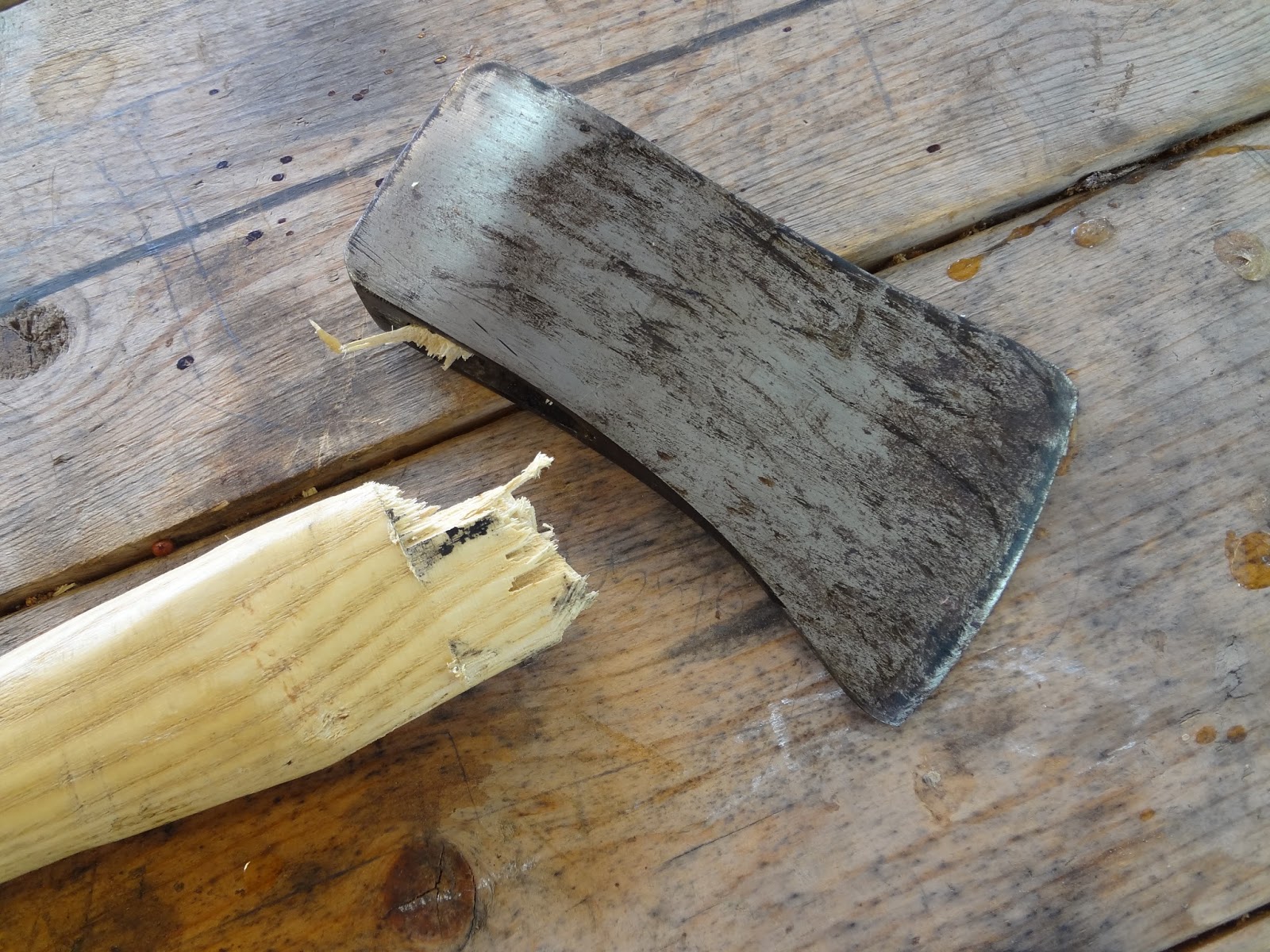
The other day I tried batoning a big chunk of dry mesquite with three of my heavier “woods roamer” knives.  Two of the knives are made from 5160 leaf spring and one is made from a farrier’s rasp.  All three choppers are robust and I found them superior to using an ax because I could pick and choose where to baton the blade spine in order to severe the log.  A few minutes before we’d broken an ax handle when we tried batoning it on another mesquite log and the baton accidentally struck the handle.  Of course, we had no problems with the big choppers.


I’ve been told the reason people are so gung-ho about batoning with a small knife is because it shows how one cutting tool can do it all.  Well, maybe.  But I doubt it.  Besides, if I were in the North Country I think I might prefer a small ax and a couple of decent pocket knives to any typical bushcraft blade.  Even a mini-ax might be preferable but then that’s just my opinion and I have a fondness for small axes.  Besides, I’ve seen Scandinavian blades fold like wet coffee filters when struck against really hard wood like mesquite, Texas ebony, guayacan and brasil.  But a small ax or a well-built chopper like the ones I’ve made for myself work beautifully.  You might try making a chopper for yourself if you’re so inclined.  Of course, I can always just pick up an armful of rotting mesquite branches (watching out for scorpions et al) and forget the ax or the chopper and the knife altogether.  And that’s what I usually do.

Wednesday, September 4, 2013

The Lady in White....

The Lady in White by Adriana Martinez

People say she was a school teacher who became pregnant by a married man.  It was in a small town, a village actually, surrounded by little ranches and secluded homesteads and for the most part the people kept to themselves.  The village had a one-room school and most kids arrived every morning on horseback.  To the south Mexico was in the midst of revolution and word had it that a war was brewing in Europe and that maybe the US was going to find a way to get involved.  Fort Ringgold in Rio Grande City along the river had been re-garrisoned to defend the citizenry from the ongoing conflict in Old Mexico.  But now and then a bandit or two would sneak across to gather up stores for himself and his clan.  Bad hombres but then so were the Texas Rangers who had flocked to the area to “safeguard” the people.  They killed with the same impunity and plundered with equal savagery.  It was a hostile time all around.

Where she came from is open to some dispute but as the story goes she arrived from somewhere down river—perhaps the town of Brownsville though some say it was actually Corpus Christi.  She was a lovely young woman, people say.  Fair of skin with wavy brown hair and eyes the color of leaves in springtime.  And he was young and handsome though not necessarily inclined towards fidelity if, per chance, an opportunity made itself available.  How they first met seems to coalesce on a story that has floated through the region as if on a bewildering fog that sweeps overland in the wee morning hours only to vanish at the first hint of dawn.  It was a simple meeting about his seven year old son who had missed several days of school due to an accident involving a small shredder.  His cuts were mostly minor except for one that had ripped into his right knee and he had developed a limp and persistent pain that on some days made walking difficult.  With his son in the buggy he rode the three miles to the school house one afternoon.  The children had left and he found her sweeping the room where the students took their daily lessons with the younger children in the front row and the oldest along the back.  They say that when he first saw her he was smitten straightaway.  Her skin was like rich milk and her eyes large and oval.  She had a natural curl to her hair that swooped downward in swirls.  At twenty-three years old she was seven years his younger.  Perhaps the attraction was as much in her heart as his for as the story goes the liaison was not long in the making.  Where they would meet is unknown and today no one speculates on that other than to say that along the line she was with child.  People wonder why she didn’t leave to have the baby far away.  Was it that her love for him was so strong she could not contemplate leaving his side?  Such a long time ago it was.  Rest assured that the pain of a broken heart and the bewilderment of unrequited love was no less back then than it is now.  For as the story goes he told her he could not see her anymore.  And so she was utterly alone.  In the night behind a dwelling that still exists though as nothing more than a stone wall buttressed on one side by an ancient mesquite tree and on the other by a pile of sand she took her life.  It was in fact the old school house.  They found her as if asleep and dressed in a white wedding gown that some say had belonged to her mother.  He denied being the father but in a small village people know things and they were aware of what might have been going on.  On a Sunday morning in 1916 she was laid to rest at the cemetery near the old church.  It seems no one from her family, if indeed she had one, claimed her body.  Today the gravesite is hard to read as the stone has weathered and the words are unclear.  Someone used to clean the grave but no one in the little village knows exactly who it was.  Some say it was the old man who lived at the end of the road that was once the route to San Antonio far to the north.  But others claim it couldn’t have been him because he did not walk well having suffered with a leg problem most of his life.  Regardless, the grave was kept clean.  These days’ people occasionally bring flowers and pull out the weeds—as much perhaps to honor the dead as to quiet a wandering soul.  For, and this much is fact, on dark nights along Highway 1017 in and around the little town of San Isidro, Texas people have reported seeing a young woman dressed in white and holding flowers in her hand.  Others swear she carries a tin pail but no one is quite sure what that means.  She appears for only a minute but her visage is clear and real.  Is she looking for him or simply walking through the night?  No one knows for sure.  She never speaks but sometimes she seems to have a mischievous quality in that she will stand in front of people refusing to move.  Some people have tried talking to her asking what it is she wants.  But she never replies.  She was spotted recently walking alongside the paved road in the early morning hours.  A few weeks before that she was seen walking down a narrow trail that circles the old church near the cemetery.  Sometimes a year or two will go by without any sightings.  But I think it’s just that no one has looked in the right place at the right time.  When the pauraques whistle on moonless nights it means she is wandering through the village…or so an old woman told me not long ago.  I heard the pauraques the other night and I also heard a noise not unlike that of a baby crying far off.  I walked out on the porch and saw a barn owl whisk overhead; and later the coyotes started wailing in the far distance.  But I saw and heard nothing more after that.

Arturo Longoria

Sunday, September 1, 2013

The Hunting Knife....

Hunting knives are, as the name implies, tools designed for processing game.  Gutting, skinning, fleshing, de-boning; the objective is to reduce an animal to parts usable for food, clothing and shelter.  The best hunting knives are neither cumbersome nor are they fragile.  They are not ponderous either!  They must remain sharp despite long periods of use and should be robust enough to fracture bones and sever joints and still keep a keen edge in order to continue the work at hand.

Most modern hunters don’t do much beyond gutting their quarry.  The animal is then transported to a butcher shop where band-saws (designed for larger animals like cows) are used to process the game into steaks, roast, ribs etc.  In those cases a decent pocket knife works just fine for gutting.  But I only used a butcher on one occasion and was sorely disappointed afterward.  Bone fragments abounded.  White-tailed deer bones are fragile and when struck by a large band-saw will invariably splinter and fragment into dangerous pieces.  A friend of mine accepted a deer steak from an acquaintance and then lost his tooth when a bone chunk split one of his molars.  Six thousand dollars later and a painful root canal and my friend still lost his tooth in the end.

For many years I’ve done all the processing myself from gutting to de-boning.  So after decades of handling game I’ve developed my own criteria of what works best.  What I don’t like are knives made from cheap steel.  Years ago I bought a set of Gerber hunting knives.  They were stainless steel and though they weren’t cheap I think the steel must have been either 420 or 440A because those knives drove me nuts.  They would not hold their edges and during field dressing I was constantly forced to re-sharpen them.  The experience with those knives soured me on Gerber products and on any knife made with either 420 or 440A stainless steel.  Others have varying opinions and I certainly respect their ideas but when it comes to dressing out game I think I’ve circled the block enough times to know a thing or two.


I recently posted a column about Old Hickory Knives with “Nessmuk” alterations and I still consider those 1095 carbon steel knives some of the best made.  They are inexpensive too.  If someone wants to go out and process a deer from “on the ground” to “in the freezer” then you can’t go wrong with an Old Hickory knife from Ontario Knife Company.  I’ve used the skinning knives—mainly re-profiled to fit my needs—as well as other styles of Old Hickory knives.  As mentioned in the previous post these carbon steel knives are tempered down a bit to allow for easy sharpening and they will stain after use.  But as far as I’m concerned that’s just adding character to the blade’s appearance.  One thing you do have to watch for is rust.  All carbon steel knives rust if not properly cleaned.  Some years back I gave a Mora 510 knife to someone and he threw the knife into his fishing tackle box and used it frequently but apparently never cleaned it.  The result was a rusted-out mess.  You’ve got to clean those carbon steel knives!  But in my opinion nothing beats quality carbon steel tempered into the 55-58 Rc range for field dressing and de-boning.  As to what is the best bevel grind for hunting knives?  My vote goes for a shallow convex grind over the Scandinavian grind or any hollow grind or flat grind.  My reason is based on the potential fragility of the Scandinavian grind (and the other grinds mentioned) when working through bone.  I’ve seen “Scandi” grind blades buckle and fold under that kind of pressure and force.  The convex grind on the other hand is stronger and thus, in my opinion, preferred when working meat and especially bone and cartilage.


I enjoy making knives and so, of course, I’ve made a number of dedicated hunting knives.  In fact, I’ve got several in various stages of construction as I write this piece and if it ever cools down around here I might get out to the workshop and finish them.  But two in particular have been used on more game than I can remember.  They were both made from steel mill files with handle scales fashioned from an old fence post I acquired in North Texas that had been in the ground about 80 years.  The wood is Osage orange and as many of you know that makes a pretty darn good selfbow.  But it also makes good knife scales and even wooden spoons though not as fancy as what you might get from a piece of mesquite or some other Brushland hardwood.  Both knives use brass pins to help secure the scales.

Some well-used hunting tools. Two homemade knives and a 40-year old Estwing Ax.


In these years of many memories I tend to approach the subject of hunting with a degree of reverence.  Life and death become weighty subjects over time.  My game processing talents are more often used in working on somebody else’s kill than my own.  With four sons I’ve got that option.  I walked those paths years ago and so I understand that innate drive.  I just don’t possess the passion to pull the trigger or release the string like I did in the way back once upon a time.  Still, a knife is something that awakens the collective unconscious and speaks of an archaic ancestor or perhaps several dozen.  In those memories I remember a kid who gutted deer, hogs and other things with broken glass bottles because he didn’t want to get the hunting knife his granddad had given him dirty.  The knife was proudly displayed and used at the table in the cabin where woodsmen gathered to feast on venison and other vittles.  Now and then it might have been used to fashion a stake for a spring trap or canvas tent.  But otherwise, it was too precious a thing to get grimy.  Any razor-like glass shard will do the trick.  And in that sense maybe the kid was closer to those distant ancestors than he realized.