Monday, November 26, 2012

César’s Birch Bark Canoe


In the early 1970s I was living in Southern Michigan spending most of my free time wandering the deciduous forests and visiting the few people I could find knowledgeable in primitive technologies.  I was supposed to be in college but found traditional education boring and, besides, I was of the type who preferred being left alone to read in a library than to sit and endure a professor’s lecture.  Having grown up in the Dark Ages when kids had to make their own fun instead of buying it at the store or fixated to some computer game I built my own push carts and model rockets and made knives and tomahawks (I grew up next to a blacksmith shop) and as a teenager I roamed the woods learning to identify native plants, hunt and track animals, and everything I could on woodcraft and primitive skills.

But oh how I wish I could have met César Newashish.  César was a Cree Indian who made birch bark canoes. And just to think that when the following film of him making one of his canoes was made I was living only a few hundred miles to the south.  I could have driven to his home in a day.  Maybe he would have allowed me to watch him make a canoe.  Perhaps I might have even been given a chance to help.  If you watch the film, then please note his expertise at using a crooked knife.  Also note that he uses no sophisticated electronic machinery but only hand tools.  His equipment consists of a pocketknife, a butcher’s knife, a handsaw, hand drill, hammer, awl, axe, and his crooked knife.  His crooked knife looks traditional in that the blade appears attached to the handle with cordage and the blade itself was probably a mill file annealed, shaped, heat treated and then tempered into a knife.  The “crook” looks well used.  The handle is crude and seems to have been made from a piece of board.  The blade length looks around 4.5 inches or thereabouts.  Actually, I think he was using two crooked knives in the film.  One of the knives seems to have been made from a six-inch mill file and the other from an eight-inch mill file.  See if you can tell the difference.  Some have suggested he might have used two pocketknives but I have not seen that when I’ve watched the film.  Some years back I ordered the DVD and I have watched the documentary dozens of times.  I learn something new each time I watch.  I hope you enjoy it as much as I do.

You can watch the film here:

Or here:

Tuesday, November 20, 2012

On Writing and Making Knives


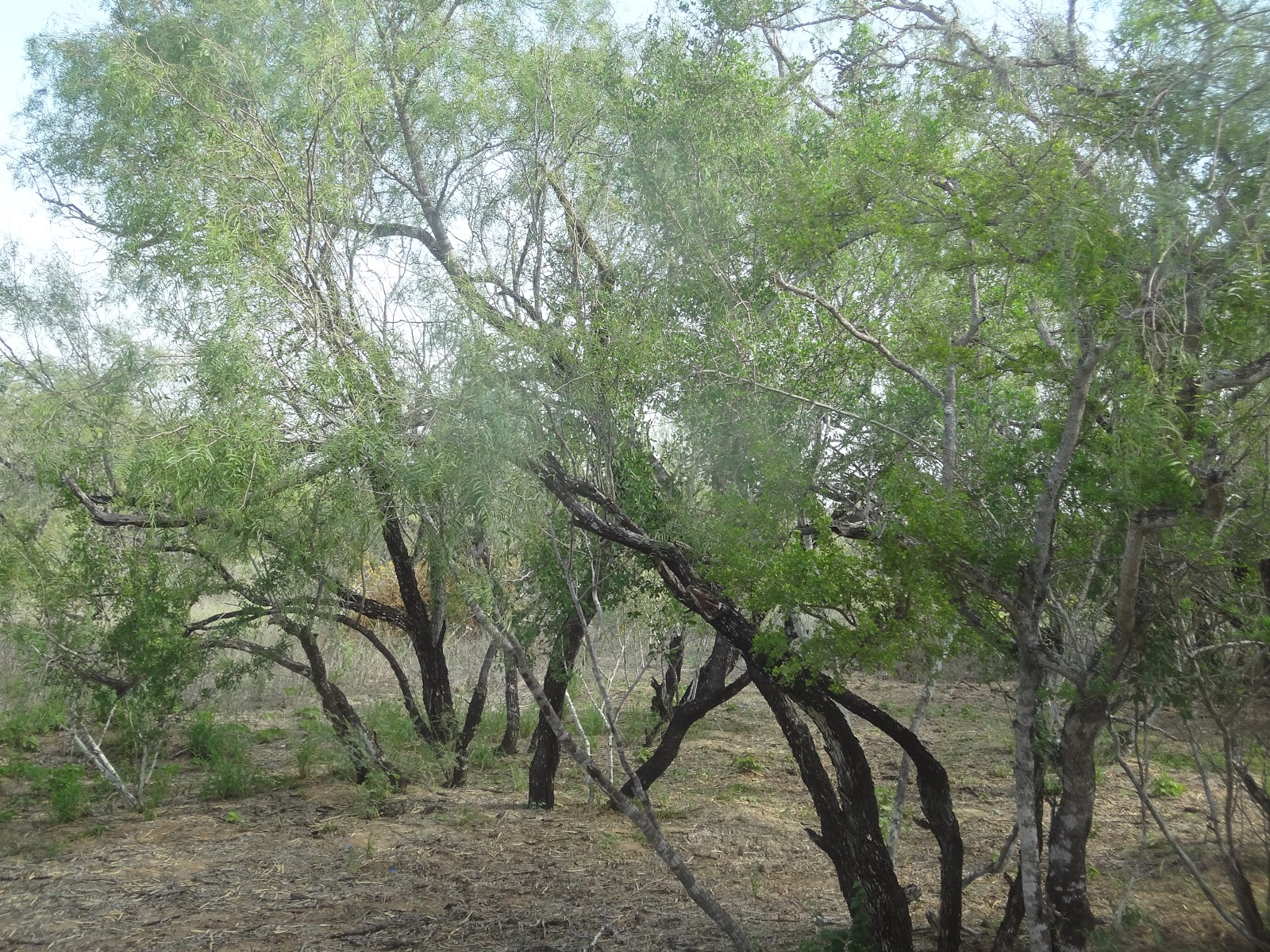
Standing within a granjeno-mesquite mott

Admittedly there are those who love crowds but every time I go into the city I get tense.  Congestion and crazy drivers: I saw a girl driving and texting and at first I thought she was drunk because she was weaving all over the road.  I’ve seen women applying their makeup while driving and some years back two of my sons saw a fellow playing an accordion and driving at the same time!  Running red lights has become the norm in some places.  So smart drivers wait at least a second or two before venturing out when the light turns green.

After a day in town I yearn to get back to my place in the woods.  I go to the city about once every ten days for supplies.  I could pare that down to once a month and save even more on gasoline.  But then gas really isn’t the issue.  I’d be sparing myself the aggravation of enduring the crowds.  I should work on that.  It would just mean a bit more planning.

My mornings are reserved for writing and the afternoons are spent goofing around in the shop or wandering in the woods.  I’m working on a book right now about life on the South Texas Sand Sheet.  It encompasses both the natural history and human history of the region—a land without surface water stretching from the southern Gulf Coast inland for over a hundred miles.  To the south and north of The Sand Sheet lie urban centers but this place is still remote.  When the Spanish first traveled through the region they saw little evidence of human habitation.  A scattering of archeological digs, however, have shown that at the end of the Pleistocene and beginning of the Holocene there were human settlements abutting the few arroyos that once traversed the land.  As the sands swept inland from the sea shelf that eleven thousand years ago extended about 100 miles farther east than it does today the arroyos were covered and the flora changed dramatically.  Without water prehistoric people found it impossible to traverse the Sand Sheet.  As such it was both a barrier restricting trade and idea diffusion from both the north and south.  Trade routes had to wind around the Sand Sheet’s western edges.  But the horse changed all of that.  My paternal grandfather drove horses across the Sand Sheet north to East Texas to sell them to the US Army in the late 1800s.  People eked out their lives on the Sand Sheet drilling wells that were frequently brackish.  Sometimes settlers relied on rainwater collection.  It was a place of both peace and violence to both people and the land.


The South Texas Sand Sheet

When I’m in my shop I work on making knives or bows or carving bowls, spoons or sometimes experimenting on various projects.  I’ve got four Woods Roamer knives ready for hafting.  I’ve got a mega chopper made from a leaf spring that’s ready as well.  That makes five cutting tools waiting their handles.  During the summer it was too hot to work in the shop except at night and even then it was often too warm.  But now things are cooling down somewhat and I’m spending more time at my little shed.  A couple of nights ago I fired up the charcoal burning forge and pounded out six Woods Roamer knives.  I annealed then afterwards and will look at them this afternoon to see if the annealing was adequate.  I’ll shape them in the next week or so and so I should have five additional knives ready for sale.

I think I’ll make the handles on this new batch of Woods Roamer knives a tad larger because that aids in chopping.  If the handles are too narrow then it’s harder to get good control when whacking away at a branch.  I want to do more videos and hopefully I’ll get the chance soon.  In the Brushlands and Southwestern deserts the two main cutting tools are a machete of some sort and a pocket knife.  The traditional bushcraft knife is not as important in this region as it seems to be in others.  I’ll go into that in detail in a future post and video.


Sunset Photo of Sand Sheet Mott

Wednesday, November 14, 2012

The Indispensable Flashlight


Never go walking in the South Texas Brushlands without carrying a flashlight.  Never!  This advice comes to you via a fellow who a long time ago was a reckless kid who was fortunate in being a good runner but had a nasty habit of never returning to camp before sunset.  As such I ran back on many occasions figuring that if I was traveling fast enough a big rattler crossing the trail wouldn’t have time to implant its fangs into me.  At least that was the theory.  But besides needing a flashlight to illuminate the path you also need a light in case something happens and you are forced to make a quick camp.  A lot of people recommend a headlamp and that is good advice.  I usually use a small AA handheld light because it seems to work okay for me.  Maybe someday I’ll use a headlamp.  But that’s not the point.  The main thing is to carry some sort of light.  Besides rattlesnakes you’ve got to contend with prickly pear cactus and dozens of thorn-bearing woody shrubs and trees.  When I’m tracking someone I always know if they were walking in the day or night by whether or not they avoid cactus and thorny shrubs or amble into them.  Once I found a fellow who was so covered with cactus spines he looked like a human pin cushion.

At night you also must deal with scorpions, pamorana ants and centipedes and you don’t want to sit anywhere or pick up anything without inspecting it first.  You’ll need a light.  There are also vicious shrubs like mala mujer and stinging cevalia that will leave burning welts on your skin that will last for days sometimes weeks.  The bottom line is that carrying a flashlight is prudent and has the potential to save your life.  Make sure your flashlight is dependable and always carry an extra set of batteries on you or in your pack.  You don’t want to be out in the deep woods and find out your batteries are caput.  I prefer LED type flashlights because they are brighter.  So carry a light and save yourself the agony of having to run back to camp.

Tuesday, November 13, 2012

Goodbye my friend...


Those of you who keep track of this blog know that I am a man of traditional values deeply committed to my family and to the preservation of nature.  I live in a cabin in the South Texas Brushlands and the nearest settlement is about four miles away.  I go for weeks here in the woods and seldom journey into town.  I don’t get lonely for town life or for anything relating to the city; and the only loneliness is for my boys who are now grown and living far away.  There is not an hour in any day that I do not think of them.  Of course, I consider my dogs part of my family too and if you keep abreast of this rag you know how much I care for my Blue Heelers.  But this year has been particularly hard for me.  Last April I lost Chucha who was bitten by a rattlesnake and did not survive.  About a month afterwards Chula, who was 15 years old at the time, died of natural causes.  She had been deaf since birth (a common genetic quirk with Blue Heelers) and veterinarians were always amazed she’d lived so long.  But she was loved and looked after and though she never heard our voices she was always attuned to our every need.  Chula watched after my youngest son when he was little.  She would herd (heel) him and keep him from venturing out too far.

Chula’s brother, Dingo, was the king.  He was the greatest Blue Heeler I have ever known.  He turned 16 years old this past summer.  He was blind and deaf now from old age.  His teeth were nearly all gone.  But in his youth he was fierce and no one messed with us under any circumstance.

Even in his old age he always went walking with me keeping close by following my scent; and even though he’d developed arthritis and sometimes had a limp he kept going.  Dingo never complained.  He was given medicine to help his joints and he was fed special food to ease his chewing and he was always eager to go out woods roaming.  If the wind changed or if I happened to amble off the path then Dingo would sometimes get lost and I had to walk back and find him and make sure he stayed close.  I had thought about getting him a leash and I’m sure he wouldn’t have minded but somehow I just couldn’t do that to him.  He was too regal and noble to be walked with any sort of cord around his neck.  Besides, we live in the woods and only city dogs get paraded around that way.  Dingo was free to take the path as he wanted.

Lately, Dingo’s eyesight was getting really bad.  I think he was nearly completely blind suffering from cataracts and perhaps he could only make out vague shapes or colors.  When I’d call him he wasn’t sure where I was and I’d have to walk around to let him know where I was standing.  Besides his poor eye sight, his hearing was nearly nonexistent and yet amazingly he could hear certain types of sounds.  The United States Navy has an airbase about 190 miles northeast of here and they sometimes train in dogfighting overhead.  They figure that since no one lives out here but an old grizzled hermit named Longoria then it doesn’t matter if they chase each other at 20,000 feet.  I don’t even pay them much attention since it kind of sounds like thunder high overhead.  And besides, they only dogfight about twice a week and I figure I can put up with those rumbling jet engines for a few minutes as part of my contribution towards national defense.  But the dogfights drove Dingo crazy.  He’d start yelping and crying and moaning as if he were about to get attacked.  Maybe he thought it was some sort of wolf howling in the distance.  I don’t know but when the jet fighters chased each other overhead then Dingo would start pleading for mercy.  It never failed.  Bring the jets and Dingo starts to wail.

There’s a tiny little road about fifty yards beyond a thicket in front of my cabin.  It’s the two ruts that I take to get to the first locked gate on the way out to the world beyond.  Dingo liked to sit at the end of my driveway at the edge of the little road keeping guard.  Granted he couldn’t see or hear anymore but nonetheless he would station himself out there just in case….well, just in case of what I’m not sure but anyway, just in case.  I think in every dog is a yearning to chase cars and Dingo spent his time out there waiting for the car that never drove past since nothing comes by except an occasional wandering coyote, a trail of leafcutter ants, free-ranging dung beetles or manic roadrunners.  But Dingo was a positive thinker and he was out there just in case.

I didn’t take Dingo walking yesterday because I was too tired.  I was up before daybreak and at sundown I was still working and after a shower and supper I drifted off.  At sunrise I got up and made coffee and my usual oatmeal and blueberries with my homemade date/cranberry bread with peanut butter.  Gave the doggies their treats and noticed Dingo out at the edge of the driveway asleep.  Sent Maggie out there to wake him up.  It was a nippy morning and Dingo was awake in an instant and trotted back for his cookie.  That’s my last impression of my beloved Dingo.  You see he did finally get his chance to chase a vehicle.  But he was blind and it ended badly.

I buried Dingo at the edge of the driveway looking out on the two rut road that leads to the first gate.  I think Dingo will like that.  Just as I was packing down the dirt around the grave a couple of US Navy fighter jets flew overhead at about 10,000 feet.  I could’ve sworn one of the jets dipped its wing and damnit but I think I actually saw the pilot bring his hand up and offer a salute.  Yep, I’m pretty sure of it.  Dingo couldn’t cry back like before but I’m doing a little bit of that now for him…if you don’t mind.


Wednesday, November 7, 2012

Our Pledge To Save the Land


Here in the United States we have been given a chance to reclaim the land from those who seek to profit and benefit from its destruction.  The “drill baby drill” and “anti-nature” crowd that arrogantly espouses raping the land in order to satisfy their greed has been denied, at least for now, the opportunity to further their agenda.  Despite spending mega-millions to ensure that their plans to pollute at will and destroy with impunity be secured, the citizenry has spoken and we all hope the leadership echoes the people’s will and not the yearnings of a few.  Words like “conservative” and “conservatism” have been so obfuscated and muddled that they now stand for avarice, hedonism and vanity instead of preservation, frugality and a moral conscience.  It would seem that to be a conservative these days is to be one who believes in polluted waters, toxic air and a ravaged landscape.  Even as we see clear evidence of our own folly when it comes to how we have treated nature there are those who persist in their denials so steeped are they in narcissistic behavior and materialism.  For those of us who dearly love the land and nature and who have spent our lives trying to protect it let us take solace in this victory and reaffirm our declaration to work always towards saving the land.

Monday, October 29, 2012

Bushcraft and Woodcraft and My Approach to Living in Nature


Here’s a question I’m asked often in my emails:  In your opinion is bushcraft and woodcraft the same thing and how do you define your personal approach to living in nature?

In a general sense I think people conceive of woodcraft and bushcraft as one in the same but neither term explicitly defines my interests.  Both bushcraft and woodcraft have traditionally referred to developing essential survival skills in nature.  But I am probably more interested in what’s known as ethnobotany or the way people employ native flora in their lives both past and present.  This can relate to using plants for food or medicine but it also suggests how plants are used for making shelters, weapons, musical instruments, cooking utensils, cosmetics etc...  The list is extensive and includes things as mundane as what are the favored woods used in cooking or what plants were used for toilet paper.  Of course, I have other hobbies like making knives used for woodworking or in my daily activities here in the brush.

My quest to discover what woods make the best selfbows in the Coahuiltecan Geographical Region would probably be considered a classic ethnobotanical pursuit.  It becomes a matter of performing experiments like replicating models and styles in order to perform experiments that provide data on compression/tension, specific gravity, workability with stone tools as well as drying techniques and what lengths of bows might have been favored.  The same applies to arrow making.  I find the general skills associated with bushcraft or woodcraft interesting but to be honest they don’t go quite far enough to sate my scientific interests.  One of my favorite pastimes is roaming the woods looking for new species of plants.  In fact, I find it hard to simply walk from point A to point B because I am invariably meandering from place to place examining plants.

My personal interests towards living in the woods stem from a combination of innate qualities and an education in science; but to be honest it is probably much more related to my personality type than anything else.  I have been a nature nut since childhood.  I was also lucky in that I had a grandfather who introduced me early on to how plants are used by people for both food and tools.  While I’m on the subject you might want to take a test to see where you fall in the personality department.  The Briggs Myers’ test, based on the theories of Carl Jung, is one of the best personality inventories available online.  You can take the test here if you are curious:

It would be interesting to learn what personality types gravitate towards things like bushcraft/woodcraft or environmental awareness etc.  In case you’re curious I’ve taken this test, and similar tests, dozens of times and I always score the exact same thing.  I am an INTJ.

For me bushcraft or woodcraft are ancillary components of living in the woods.  The terms were not even that well known to me until adulthood.  When one lives in the woods and grows up in the woods and has lived amongst people who did the same then bushcraft and woodcraft are tantamount to what a town’s dweller would think of when driving a car or mowing a lawn or tightening the hinges on a door.  In other words, it’s just what one does.  Live amongst native people in remote villages whose dwellings are prehistoric in design and who are experts in both edible and medicinal plants, and who track, hunt and forage as part of their daily lives and you quickly realize how terms like bushcraft and woodcraft are more the property of those who find such activities novelties—a set of skills to be learned while living in a world in which those same skills are unneeded.  A raft of television shows about people struggling to survive in the woods should be proof enough that a fascination exists about primitive living skills even if the players themselves are essentially neophytes.  In truth, expertise comes in only one form when related to wilderness knowledge: It is always regional and always the outcome of lifelong experience.  If you haven’t read this post then please read it.  

I know intimately, for example, the desert and brushlands but I am a greenhorn when in any other territory.  The scenario of dropping so-called experts into distant lands to find their way home is nothing more than drama.  Without a film crew and local experts they would all be dead pilgrims in a week or two…so much for universal expertise and welcome to the world of Hollywood.  In effect, it can be an extensive learning curve if you are so inclined and encoded.  Start at about the age of six months and never look back until they plant you or the wolves get to take their share.

Tuesday, October 16, 2012

Bird Habitat: How to enhance it and How to ruin it


Big birds, little birds and in between; some of my fondest memories are centered on experiences involving birds.  Like when I was a kid roaming the woods along the San Fernando River in the state of Tamaulipas, Mexico and listening to ghost doves (white-tipped doves) cooing hauntingly from the trees around me and then running down to the river to catch glimpses of chachalacas along the water’s edge.  The ranch was called El Cuervo, The Crow, and there were tens of thousands of both crows and ravens.  During parts of the year white-winged doves clouded the sky and I was forever searching for glimpses of the seven different owl species that frequented the area as well as keeping records of the varieties of hawks I saw.  In other places my memories are back-dropped by the echoing calls of rufescent-tinamous and watching yellow headed parrots squawking loudly as they flew from one spot to another.  I recall a hike through a canyon where mot-mots and brown jays shadowed me for hours.


I have four watering stations in my front yard and at first light I look out my cabin windows to see if the birds have arrived.  This year migrating hummingbirds were stressed by the severe drought that nowadays seems a part of everyday life.  A preview of a world we live in beset by rising temperatures and tortured by a lack of rain.  Who do you trust to take care of the land and safeguard the air and water?  So I set out a hummingbird feeder as have hundreds of others in the region to help hummingbirds on their journey south for the winter.


Providing good bird habitat is not a hard thing to accomplish.  It doesn’t require a lot of money or exorbitant effort.  Nor does it demand a mountain of bureaucratic research.  It does, however, involve having a conscience and a bit of empathy.  One has to think beyond self.  I read an article in a pamphlet recently about quail habitat.  Bobwhite quail populations have experienced a rough time as of late due mainly to the effects of human behavior.  Whether the result of imported fire ants swarming chicks or feral hogs released into the wild where they search out quail eggs or debilitating droughts or urban sprawl or pesticides or fragmentation, the results are that bobwhite quail numbers have plummeted in many places.  In the article mentioned above a biologist was quoted as saying, “The efforts [to study quail] will allow us to test the hypothesis that, given enough usable habitat [sic], we can sustain viable populations of quail over boom and bust cycles.”  While it’s true that bobwhite populations wax and wane naturally perhaps the problem stems not from these natural phases but from attempts to commercialize the entire process for hunting.  In other words, it’s not about providing habitat, at least not in this case, but instead about producing birds to make money off of through shooting.  Regardless, it is relatively easy to gauge the value of one’s hypothesis by simply reversing the question and running it backwards.  Allow me to explain.  What if we were to say: The efforts [to study quail] will allow us to test the hypothesis that, given the eradication of all habitats, we can annihilate viable populations of quail regardless of boom and bust cycles.  In other words, this is not a hypothesis; it is simply a matter of what some might call common sense.  While it’s true that specific animals have specific needs it is also true that species and habitats tend to coalesce over time.  Where massive mono-dimensional agricultural practices have replaced multi-dimensional diverse habitats we see a corresponding decrease in animal numbers and diversity.  The Lower Rio Grande Valley of deep South Texas was at one time a birding wonderland.  Extensive agriculture coupled with nauseous urban sprawl has reduced the value of South Texas birding considerably.  It just ain’t what it used to be.  In many places all you see are millions of great-tailed grackles, Brewer’s blackbirds and brown-headed cowbirds.  There are still interesting birds to see but their numbers have decreased dramatically over the years.


So then what is the key to providing good bird habitat?  It boils down to three things.  1) Nature 2) Water 3) Minimized Predation.  What good will it do if you build a sanctuary with lots of trees, shrubs and vines and plenty of watering sources if next door there are ten thousand stray cats that will come in and wipe out your birds in a matter of days?  I’ve seen that exact phenomena in many places.


On any given day I’ll have from four to six large coveys of bobwhite quail in my front yard.  I do not shoot them and I will not allow anyone else to shoot them.  They are part of my extended family.  Just like the cardinals, green jays, scores of doves, pauraques, painted buntings, vermillion fly catchers, pyrrhuloxias…the list goes on and on.  I keep nature close to the house.  I provide water.  Now and then a Harris hawk or Coopers hawk or Swainson’s hawk will lite on a branch and survey its next meal and then gorge on a tasty morsel.  Every once in a while an Indigo or Corn snake will find a clutch of eggs and do the same.  It’s understandable.


Not long ago I owned a lot and house in a nearby city.  I’d spent years providing bird habitat.  It was a small city lot but nonetheless I tried my best to blanket the free space with foliage.  Besides keeping the house nicely shaded and thus reducing utility bills I had birds like no one around me.  I found great pleasure in working to assure that the yard was truly a piece of nature amidst miles of concrete, asphalt and urban noise.  When I sold the property I hoped the new owner would likewise be a nature person.  To my shock I drove by the property a few months afterward and the new owner had removed every tree, shrub and cactus from the lot.  It was horrific.  Why would anyone be so inconsiderate, I wondered?  The giant trees were no more.  All I saw was brick and lumber.  I never went back.